Word of the Day: Hilarious
Today’s word of the day is hilarious. Just a side note before I launch in. One of the reasons we use italics in writing is to indicate that a particular word is being presented as a word and not with its actual meaning. If I said, “Today’s word of the day is hilarious,” I would be saying something like, “Today’s word of the day is very funny.” But by using italics, my reader can tell that I am talking about the word rather than using it with its meaning. Okay, but I thought it was funny.
Pronounced / hɪˈlɛər i əs / or / hɪ ˈlær i əs / (the website also suggests / haɪˈlɛər i əs /, but I cannot imagine an educated person pronouncing it that way), the adjective means “arousing great merriment; extremely funny” or “boisterously merry or cheerful” (https://www.dictionary.com/browse/hilarious).
The word first appears in English in “1823, ‘cheerful,’ from Latin hilaris ‘cheerful, lively, merry, joyful, of good cheer’ (see hilarity) + -ous. Meaning ‘boisterously joyful’ is from 1835” (https://www.etymonline.com/word/hilarious). Hilarity appears much earlier, in the “mid-15c., from Latin hilaritatem (nominative hilaritas) ‘cheerfulness, gaiety, merriment,’ from hilaris ‘cheerful, merry,’ from Greek hilaros ‘cheerful, merry, joyous,’ related to hilaos ‘graceful, kindly,’ hilaskomai ‘to propitiate, “In ancient Rome, Hilaria (neuter plural of hilaris) were a class of holidays, times of pomp and rejoicing; there were public ones in honor of Cybele at the spring equinoxes as well as private ones on the day of a marriage or a son’s birth” (ibid.).
Just to finish the etymology off, the –ous is a “word-forming element making adjectives from nouns, meaning ‘having, full of, having to do with, doing, inclined to,’ from Old French -ous, -eux, from Latin -osus (compare -ose (1)). In chemistry, ‘having a lower valence than forms expressed in -ic’” (ibid.).
On this date in 468, according to the On This Day website, the Roman Catholic Church elected St. Simplicius to be the new Pope.
Simplicius did quite a bit to hold the Roman church together at the end of the Roman Empire. He combatted the Eutychian heresy (which concerns the Church’s view of the relationship between the humanity of Jesus and the divinity of Christ—it’s really kind of complicated), defending the decisions of the Council of Chalcedon (451). He was the Pope when Romulus Augustus (referred to as Augustulus) was deposed in 476, the last of the Western Roman Emperors, and he managed to keep the Church of Rome in control of the city after Odoacer defeated Augustulus’s father, Orestes (https://en.wikipedia.org/wiki/Pope_Simplicius).
“According to the Carolingian liturgist Amalarius of Metz, Pope Simplicius was the first pope to carry out consecrations at any other time than in December before Christmas. He began to confer holy orders in February as well.
“Simplicius is credited with the construction of a church named Santa Bibiana, in memory of the virgin and martyr St. Bibiana. He also dedicated the Church of San Stefano Rotondo on the Celian Hill, the church of S. Andrea near S. Maria Maggiore, and a church dedicated to Saint Lawrence in the Campo Verano. He labored to help the people of Italy against the marauding raids of barbarian invaders (ibid.).
But there’s an inside joke with this, and that is that in 1668 Hans Jakob Christoffel von Grimmelshausen, a German writer, published his picaresque novel Simplicius Simplicissimus. “The full subtitle is ‘The account of the life of an odd vagrant named Melchior Sternfels von Fuchshaim: namely where and in what manner he came into this world, what he saw, learned, experienced, and endured therein; also why he again left it of his own free will’” (https://en.wikipedia.org/wiki/Simplicius_Simplicissimus).
Here’s the wiki’s description of the plot: “The novel is told from the perspective of its protagonist Simplicius, a rogue or picaro typical of the picaresque novel, as he traverses the tumultuous world of the Holy Roman Empire during the Thirty Years’ War. Raised by a peasant family, he is separated from his home by foraging dragoons and is adopted by a hermit living in the forest, who teaches him to read and introduces him to religion. The hermit also gives Simplicius his name because he was so simple that he did not know what his own name was.[8] After the death of the hermit, Simplicius must fend for himself. He is conscripted at a young age into service, and from there embarks on years of foraging, military triumph, wealth, prostitution, disease, bourgeois domestic life, and travels to Russia, France, and to an alternate world inhabited by mermen. The novel ends with Simplicius turning to a life of hermitage himself, denouncing the world as corrupt” (ibid.). If the plot reminds you vaguely of Voltaire’s Candide, that may be because it was likely an influence on Candide. Both are picaresque fiction, and both are satires.
“The adventures of Simplicissimus became so popular that they were reproduced by authors in other European countries. Simplicissimus was recreated in French, English, and Turkish. A Hungarian Simplicissimus (Ungarischer oder Dacianischer Simplicissimus) was published in 1683” (ibid.). And it has been an influence on many later writers, including Bertold Brecht and John LeCarre: “Grimmelshausen’s Simplicissimus is used throughout John le Carré’s novel A Perfect Spy (1986) as Magnus Pym’s permanent key for one-time pad coding, and Pym’s own life is represented as a picaresque. Grimmelshausen was used in other Le Carré novels as well.… Smiley tried to sell a prized Grimmelshausen first edition at the beginning of Tinker Tailor Soldier Spy (although it does not ultimately get sold)” (ibid.).
But there’s another little inside joke in today’s blog. The pope who preceded Simplicius was named Hilarius. Now you have to admit—that is hilarious.
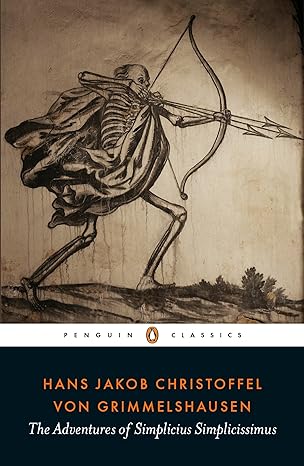
Today’s image is from the Amazon website, and it’s a Penguin edition of Grimmelshausen’s novel (https://www.amazon.co.uk/Adventures-Simplicius-Simplicissimus-Penguin-Classics/dp/0241309867). The blurb says, “A story of war in all its absurdity and horror, this incomparable novel describes the fortunes of a young boy travelling through a world ravaged by conflict, and the terrible things he witnesses. Written by someone who fought in the Thirty Years War which decimated Europe in the seventeenth century, it combines brutal, documentary realism with fantastical, knockabout humour to depict a universe turned upside down. This pioneering work of fiction is considered to be the first great German novel.”