Word of the Day: Occultist
Today’s word of the day, as we continue the theme we have been exploring lately, is occultist. Pronounced / əˈkʌl tɪst /, with stress on the second syllable, this noun refers to “a person who believes in or practices occult arts, such as magic, astrology, alchemy, seances, or other activity claiming the use of secret knowledge or supernatural powers or agencies” (https://www.dictionary.com/browse/occultist).
Merriam-Webster offers up one of those frustrating definitions: “an adherent of occultism : one thought to be proficient in occult practices” (https://www.merriam-webster.com/dictionary/occultist). So now we have to look up occultism: “occult theory or practice : belief in or study of the action or influence of supernatural or supernormal powers” (https://www.merriam-webster.com/dictionary/occultism). The adjective occult, then, can be defined as “not revealed,” “not easily apprehended or understood,” “hidden from view,” “of or relating to supernatural or supernormal powers or practices or the knowledge of them,” or “not manifest or detectable by clinical methods alone” (https://www.merriam-webster.com/dictionary/occult).
Interestingly, etymonline.com does not have an entry for occultist, and the entry for occultism is not particularly detailed. So I looked at the entry for occult. It entered into the language in the “1530s, ‘secret, not divulged,’ from French occulte and directly from Latin occultus “hidden, concealed, secret,” past participle of occulere ‘cover over, conceal,’ from assimilated form of ob ‘over’ (see ob-) + a verb related to celare ‘to hide’ (from PIE root *kel- ‘to cover, conceal, save’). Meaning ‘not apprehended by the mind, beyond the range of understanding’ is from 1540s. The association with the supernatural sciences (magic, alchemy, astrology, etc.) dates from 1630s. A verb occult ‘to keep secret, conceal’ (c.1500, from Latin occultare) is obsolete” (https://www.etymonline.com/word/occult).
On this date in 777 A.D., Saint Walpurga died.
Walpurga was born in a part of England called Dumnonia, which is “the Latinised name for a Brythonic kingdom that existed in Sub-Roman Britain between the 6th century CE and the 7th century CE in the more westerly parts of present-day South West England” (https://en.wikipedia.org/wiki/Dumnonia). “She was the daughter of Richard the Pilgrim and was raised in Wimborne Abbey in Dorset where she became a nun. Under the mentorship of her uncle, Saint Boniface, she and her brothers evangelized to pagans in Germany, particularly in the Württemberg region. Her early education meant she was one of the few women capable of writing and she wrote an account of her brother’s journey to Palestine” (https://www.occult.live/index.php/Walpurgisnacht).
“Saint Walpurga was hailed by the Christians of Germany for battling ‘pest, rabies, and whooping cough, as well as against witchcraft.’ Because she was successful in converting the local populace to Christianity, they prayed to her to protect themselves from witchcraft.
“The earliest representation of Walpurga is in the early 11th-century Hitda Codex, made in Cologne, which depicts her holding stylized stalks of grain. The grain attribute has been interpreted as an instance of a Christian saint (Walpurga) coming to represent an older pagan concept; in this case, the pagan Grain Mother” (ibid.).
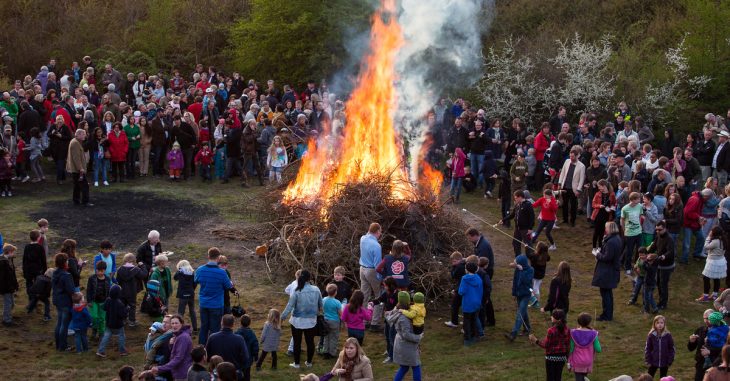
She died on February 25 of 777, and she was canonized by the Roman Catholic Church on May 1, which has become St. Walpurgis Day. That makes the evening before Walpurgis Night (Walpurgisnacht in Deutsch). “The date of Walpurgis Night coincided with an older May Eve festival, celebrated in much of northern Europe with the lighting of bonfires at night. A variety of festivals of pre-Christian origin had been celebrated at this time (halfway between the spring equinox and summer solstice) to mark the beginning of summer, including Beltane in Ireland and Britain.
“Folklorist Jack Santino says ‘Her day and its traditions almost certainly are traceable to pre-Christian celebrations that took place at this time, on the first of May’” (ibid.).
“In German folklore, Walpurgis Night was believed to be the night of a witches’ meeting on the Brocken, the highest peak in the Harz Mountains, a range of wooded hills in central Germany. To ward off evil and protect themselves and their livestock, people would traditionally light fires on the hillsides, a tradition that continues in some regions today. In Bavaria, the feast day is sometimes called Hexennacht (Dutch: heksennacht), literally ‘Witches’ Night,’ on which revelers dress as witches and demons, set off fireworks, dance and play loud music, which is said to drive the witches and winter spirits away” (ibid.).
The Church of Satan, founded in 1966, has made Walpurgis Night one of its important holidays, “noting the Eve of May has been memorialized as ‘symbolizing the fruition of the spring equinox,’ and chose the date well aware of the date’s traditional association with witchcraft” (ibid.). Wiccans also celebrate that day, but they use the Celtic name Beltane.
It’s curious that the Church of Satan and the Wiccans celebrate a night that is also the celebration of a saint who was famous for fighting witchcraft. Perhaps those are different sides of being an occultist.
Today’s image is of a Walpurgisfeuer (Deutsch: “Walpurgis fire”) (https://www.worldhistory.org/trans/de/1-18905/walpurgisnacht/).