Word of the Day: Magi
Today’s word of the day is magi. Pronounced / ˈmeɪ dʒaɪ / or / ˈmædʒ aɪ /, with a soft g, magi is the plural of magus and means “the class of Zoroastrian priests in ancient Media and Persia, reputed to possess supernatural powers” or “people who are believed to have expertise in interpreting the assumed influence of the stars, moon, and planets on human affairs; astrologers” or “in the Bible, the astrologers who paid homage to the young child Jesus, traditionally assumed to be three in number and to be named Balthazar, Caspar, and Melchior” (https://www.dictionary.com/browse/magi).
Merriam-Webster gives “a member of a hereditary priestly class among the ancient Medes and Persians” and “one of the traditionally three wise men from the East paying homage to the infant Jesus” (https://www.merriam-webster.com/dictionary/magus). It also offers as synonyms magician and sorcerer.
The word first appears in English “c. 1200, ‘skilled magicians, astrologers,’ from Latin magi, plural of magus ‘magician, learned magician,’ from Greek magos, a word used for the Persian learned and priestly class as portrayed in the Bible (said by ancient historians to have been originally the name of a Median tribe), from Old Persian magush ‘magician’ (see magic). Also, in Christian history, the ‘wise men’ who, according to Matthew, came from the east to Jerusalem to do homage to the newborn Christ (late 14c.)” (https://www.etymonline.com/word/Magus).
Magic first appears “late 14c., magike, ‘art of influencing or predicting events and producing marvels using hidden natural forces,’ also ‘supernatural art,’ especially the art of controlling the actions of spiritual or superhuman beings; from Old French magique ‘magic; magical,’ from Late Latin magice ‘sorcery, magic,’ from Greek magikē (presumably with tekhnē ‘art’), fem. of magikos ‘magical.’ This is from magos ‘one of the members of the learned and priestly class,’ a borrowing of Old Persian magush, which is possibly from PIE root *magh- ‘to be able, have power.’
“The transferred sense of ‘legerdemain, optical illusion, etc.’ is from 1811.
“It displaced Old English wiccecræft (see witch); also drycræft, from dry ‘magician,’ from Irish drui ‘priest, magician’ (see Druid)” (https://www.etymonline.com/word/magic).
Eighty years ago this month, “the Electronic Numerical Integrator and Computer (ENIAC) was unveiled at the University of Pennsylvania. ENIAC was the first general-purpose electronic computer, capable of performing thousands of calculations per second” (https://entechonline.com/historical-events-in-february/).
“One of ENIAC’s most revolutionary contributions was its ability to be reprogrammed to solve complex numerical problems. Specifically, what set it apart from other machines of the time was that it could be rewired to perform different calculations rather than being fixed for a single task. ENIAC could execute ‘conditional branches’—operations that allowed it to switch between different calculations based on intermediate results. In other words, ENIAC could perform ‘if this, then that’ operations” (https://penntoday.upenn.edu/news/penns-eniac-worlds-first-electronic-computer-turns-80).
“Earlier machines were sophisticated but limited, relying on clunky gears and rotating shafts that had to physically mesh to perform a calculation. This reliance on the physical world limited their speed.
“ENIAC, however, harnessed the flow of electrons. Using more than 17,000 vacuum tubes as near-instant switches, it was able to perform calculations far faster than mechanical relays, accelerating the development of the hydrogen bomb (known as the ‘Super’) and ushering in the digital age” (ibid.).
“Programming this flexibility required what historians have described as a ‘physical hack’ of the hardware, and the work fell to six pioneering women: Frances Bilas Spence, Jean Jennings Bartik, Ruth Lichterman Teitelbaum, Betty Snyder Holberton, Kay McNulty Mauchly Antonelli, and Marlyn Wescoff Meltzer. As the first digital-age programmers, they translated logic into electronic signals for ENIAC to interpret” (ibid.). It’s interesting that the first real computer programmers were women since the stereotype is that programmers are men.
I wonder what the engineers and programmers who created ENIAC would think of the prevalence of computers today—smart phones, cars, the internet of things.
The third of Arthur C. Clarke’s three laws states, “Any sufficiently advanced technology is indistinguishable from magic” (https://en.wikipedia.org/wiki/Clarke%27s_three_laws). “It was published in a 1968 letter to Science magazine and eventually added to the 1973 revision of the “Hazards of Prophecy” essay,” an essay that Clarke wrote in 1962 which contained his first two laws. He added to it with the third law later. ENIAC would certainly have seemed like magic to people of the past, and the iPhone might seem like magic to people in the 1940s. And I guess the users of the iPhone would look like magi to them, too.
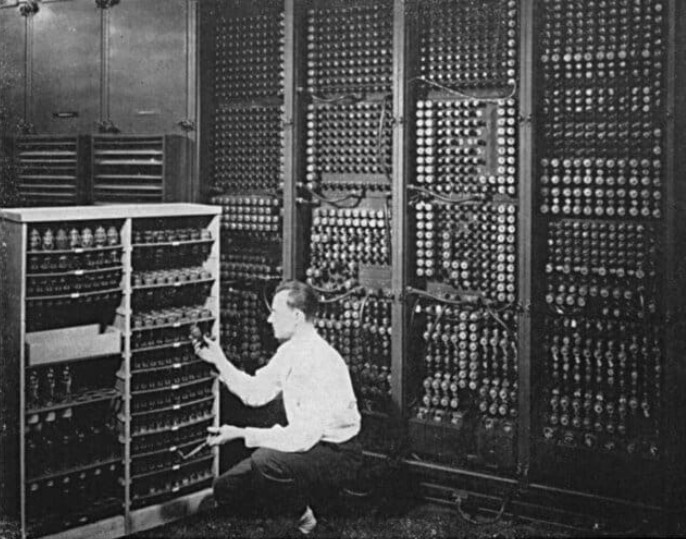
Today’s image is of “ENIAC, the first general-purpose electronic computer, undergoing maintenance.” The caption in the article says, “Replacing a bad tube meant checking among ENIAC’s 19,000 possibilities” (https://entechonline.com/historical-events-in-february/).