Word of the Day: Shaman
Today’s word of the day is shaman. Pronounced / ˈʃɑ mən /, ˈʃeɪ mən /, or /ˈʃæm ən / (although I have never heard that third version), this noun refers to “a person who acts as intermediary between the natural and supernatural worlds, using magic to cure illness, foretell the future, control spiritual forces, etc.” (https://www.dictionary.com/browse/shaman).
Merriam-Webster says that it is “a priest or priestess who uses magic for the purpose of curing the sick, divining the hidden, and controlling events” or “one who resembles a shaman,” though that second definition seems circular
The word appears in English in the “1690s, ‘priest of the Ural-Altaic peoples of northern Asia,’ probably via German Schamane, from Russian sha’man, from Tungus saman, which, according to OED is perhaps from Chinese sha men ‘Buddhist monk,’ from Prakrit samaya-, from Sanskrit sramana-s ‘Buddhist ascetic.’ Extended to ‘similar personages in other parts’ (OED), especially native Americans” (https://www.etymonline.com/search?q=shaman). “Tungusic peoples are an ethnolinguistic group formed by the speakers of Tungusic languages (or Manchu–Tungus languages). They are native to Siberia, Mongolia and China. The Tungusic language family is divided into two main branches, Northern (Ewenic–Udegheic) and Southern Tungusic (Jurchenic–Nanaic)” (https://en.wikipedia.org/wiki/Tungusic_peoples).
“Prakrit (/ˈprɑːkrɪt/ PRAH-krit[a]) is a group of vernacular classical Middle Indo-Aryan languages that were used in the Indian subcontinent from around the 5th century BCE to the 12th century CE. The term Prakrit is usually applied to the middle period of the Middle Indo-Aryan languages, excluding Pali” (https://en.wikipedia.org/wiki/Prakrit). “There are two major views concerning the way in which Sanskrit and Prakrit are related. One view holds that Prakrit was the speech of the common people, unadorned by grammar, and that prākṛta thus refers to vernacular usage, while Sanskrit was a co-existing but elevated register of the language. This is the usual explanation accepted by Western linguists” (ibid.). “In contrast, the view most commonly held by modern Prakrit grammarians holds that the Prakrit languages are vernaculars that descended from Sanskrit at a later date” (ibid.).
According to On This Day, on this date in 1942 “FDR orders the detention and internment of all Japanese Americans on the West Coast” (https://www.onthisday.com/events/february/19).
So as most of us remember, on December 7, 1941, the Japanese attacked the military base at Pearl Harbor in Hawaii. The goal was to knock the USA out of war before it got a chance to get involved. The Japanese had been fighting in the Pacific theater since 1931, when their army invaded Manchuria. That was followed by the second Sino-Japanese War, which began in 1937. Japan then invaded French Indochina, although that was a mistake of timing since at that point the government of France was the Vichy government. And Japan had allied itself with Nazi Deutschland. “On the same day as the Pearl Harbor bombing, Japan attacked the U.S. territories of Guam and the Philippines, and the British territories of Hong Kong, Singapore and Malaya (part of present-day Malaysia). It also invaded the independent nation of Thailand” (https://www.history.com/articles/pearl-harbor-japan-attacks-territories). In fact, after the attack on Pearl Harbor, Japan declared war on the USA and Great Britain.
In response to the declaration of war, Roosevelt issued Executive Order 9066. This order, which when you read it seems incredibly vague, allowed the military to designate certain areas “exclusion zones” (https://en.wikipedia.org/wiki/Internment_of_Japanese_Americans). The military could then decide who would be excluded from these exclusion zones. Apparently the entire West Coast was declared an exclusion zone, and people of Japanese descent were excluded. “Although the executive order did not mention Japanese Americans, this authority was used to declare that all people of Japanese ancestry were required to leave Alaska and the military exclusion zones from all of California and parts of Oregon, Washington, and Arizona, with the exception of those inmates who were being held in government camps. The detainees were not only people of Japanese ancestry, they also included a relatively small number—though still totaling well over ten thousand—of people of German and Italian ancestry as well as Germans who were expelled from Latin America and deported to the U.S. Approximately 5,000 Japanese Americans relocated outside the exclusion zone before March 1942, while some 5,500 community leaders had been arrested immediately after the Pearl Harbor attack and thus were already in custody” (https://en.wikipedia.org/wiki/Internment_of_Japanese_Americans).
What was life like for these prisoners? “According to a 1943 War Relocation Authority report, inmates were housed in ‘tar paper-covered barracks of simple frame construction without plumbing or cooking facilities of any kind’. The spartan facilities met international laws, but left much to be desired. Many camps were built quickly by civilian contractors during the summer of 1942 based on designs for military barracks, making the buildings poorly equipped for cramped family living. Throughout many camps, twenty-five people were forced to live in space built to contain four, leaving no room for privacy” (ibid.).
“Of the 110,000 Japanese Americans detained by the United States government during World War II, 30,000 were children. Most were school-age children, so educational facilities were set up in the camps. The government had not adequately planned for the camps, and no real budget or plan was set aside for the new camp educational facilities. Camp schoolhouses were crowded and had insufficient materials, books, notebooks, and desks for students. Books were only issued a month after the opening. In the Southwest, the schoolhouses were extremely hot in summertime. Class sizes were very large. At the height of its attendance, the Rohwer Camp of Arkansas reached 2,339, with only 45 certified teachers. The student to teacher ratio in the camps was 48:1 in elementary schools and 35:1 for secondary schools, compared to the national average of 28:1” (ibid.).
“On December 18, 1944, the Supreme Court handed down two decisions on the legality of the incarceration under Executive Order 9066. Korematsu v. United States, a 6–3 decision upholding a Nisei’s conviction for violating the military exclusion order, stated that, in general, the removal of Japanese Americans from the West Coast was constitutional. However, Ex parte Endo unanimously declared on that same day that loyal citizens of the United States, regardless of cultural descent, could not be detained without cause. In effect, the two rulings held that, while the eviction of American citizens in the name of military necessity was legal, the subsequent incarceration was not—thus paving the way for their release.
“Having been alerted to the Court’s decision, the Roosevelt administration issued Public Proclamation No. 21 the day before the Korematsu and Endo rulings were made public, on December 17, 1944, rescinding the exclusion orders and declaring that Japanese Americans could return to the West Coast the next month” (ibid.). The two-and-a-half-year nightmare was over.
I grew up in the 1960s and early 70s, and what I learned in school was the Franklin Roosevelt was one of the greatest presidents in our history, that he brought the country out of the Great Depression and then won World War II. What I did not learn was that this great president perpetrated one of the more racist and anti-American acts in our history. Many of my teachers treated FDR as if he was a shaman, a religious as well as political leader. But we’re all just human and prone to human mistakes. What is sad is that the mistakes of the powerful create a lot more victims than the mistakes of most of us.
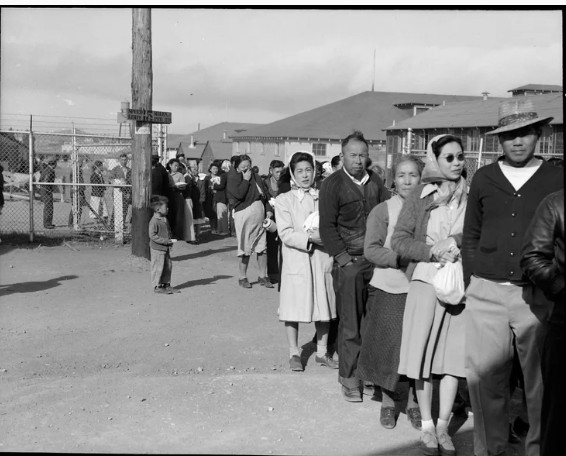
Today’s image is from “Dorothea Lange’s Censored Photographs of FDR’s Japanese Concentration Camps” (https://anchoreditions.com/blog/dorothea-lange-censored-photographs?fbclid=IwAR0-6Vb1O2j8UTkEQOg_CgnaHwJY1gJRBA0bUmX8VZW5QA25x4NG7u6cUss). “Dorothea Lange—well known for her FSA photographs like Migrant Mother—was hired by the U.S. government to make a photographic record of the ‘evacuation’ and ‘relocation’ of Japanese-Americans in 1942. She was eager to take the commission, despite being opposed to the effort, as she believed ‘a true record of the evacuation would be valuable in the future.’
“The military commanders that reviewed her work realized that Lange’s contrary point of view was evident through her photographs, and seized them for the duration of World War II, even writing “Impounded” across some of the prints. The photos were quietly deposited into the National Archives, where they remained largely unseen until 2006” (ibid.).
The caption for the photograph reads as follows: “June 16, 1942 — San Bruno, California. Supper time! Meal times are the big events of the day within an assembly center. This is a line-up of evacuees waiting for the ‘B’ shift at 5:45 pm. They carry with them their own dishes and cutlery in bags to protect them from the dust. They, themselves, individually wash their own dishes after each meal, since dish washing facilities in the mess halls proved inadequate. Most of the residents prefer this second shift because they sometimes get second helpings, but the groups are rotated each week. There are eighteen mess halls in camp which, together, accommodate [sic] 8,000 persons three times a day. All food is prepared and served by evacuees” (ibid.).