Word of the Day: Thaumaturge
Today’s word of the day, continuing the theme of the last few days, is thaumaturge. This noun, pronounced / ˈθɔ məˌtɜrdʒ /, refers to “a worker of wonders or miracles; magician” (https://www.dictionary.com/browse/thaumaturge).
Merriam-Webster says that it first appeared in 1715 and was “borrowed from Medieval Latin thaumaturgus ‘worker of miracles,’ borrowed from Late Greek thaumatourgós, going back to Greek, ‘performer of wonders (as an acrobat),’ from thaumat-, thaûma ‘wonder, object of wonder or admiration, marvel’ (probably derivative from the base of théā ‘sight, spectacle’) + -ourgos ‘performing, carrying out (the thing specified),’ going back to *-o-wergos or *-o-worgos, derivative of Indo-European *u̯erǵ- ‘make, bring about’ (whence, as a nominal derivative, Greek érgon ‘work’)—more at theater entry 1, work entry 1” (https://www.merriam-webster.com/dictionary/thaumaturge).
Theater (British theatre) comes from “Middle English teatre, theatre, borrowed from Anglo-French & Latin; Anglo-French thueatre, teatre, borrowed from Latin theātrum ‘place for viewing dramatic performances,’ borrowed from Greek théātron, from theā́omai, theâsthai ‘to gaze at, view, watch, contemplate’ (derivative of théā ‘act of seeing, sight, spectacle, performance,’ of uncertain origin) + -tron, suffix of instruments” (https://www.merriam-webster.com/dictionary/theater#h1).
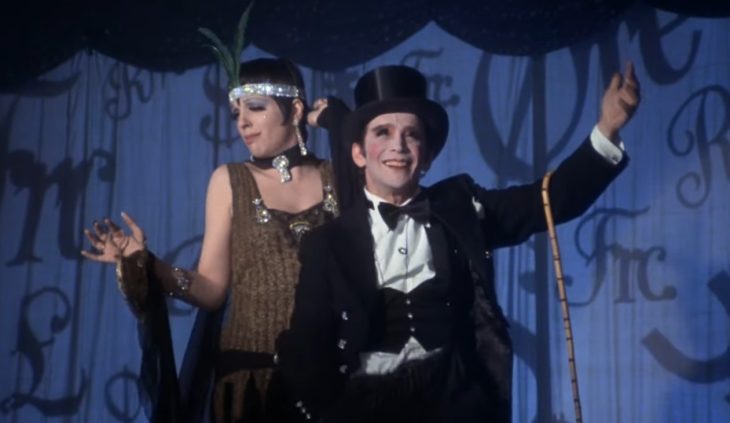
On this date in 1972, the “Film adaptation of ‘Cabaret,’ directed by Bob Fosse and based on John Kander and Fred Ebb‘s musical of the same name, is released, starring Liza Minnelli, Michael York, and Joel Grey” (https://www.onthisday.com/today/events.php).
The Broadway musical premiered in 1966 at the Broadhurst Theater, and it ran for over 1,100 performances, making it a box office success (https://en.wikipedia.org/wiki/Cabaret_(musical)). It was based upon a 1951 play I Am a Camera by John Van Druten; the play opened at the Empire Theater in November of that year and ran for over 200 performances, winning several TONY awards. The play was based upon the 1939 semi-autobiographical novel Goodbye to Berlin by Christopher Isherwood. The main character, Sally Bowles, was based upon “a 19-year-old flapper who briefly shared lodgings with Isherwood,” Jean Ross (https://en.wikipedia.org/wiki/Goodbye_to_Berlin).
“Set in 1929–1930 Berlin during the twilight of the Jazz Age as the Nazis rise to power, the musical focuses on the hedonistic nightlife at the seedy Kit Kat Klub and revolves around American writer Clifford Bradshaw’s relations with English cabaret performer Sally Bowles. A subplot involves the doomed romance between German boarding house owner Fräulein Schneider and her elderly suitor Herr Schultz, a Jewish fruit vendor. Overseeing the action is the Master of Ceremonies at the Kit Kat Klub, and the club itself serves as a metaphor for ominous political developments in late Weimar Germany” (https://en.wikipedia.org/wiki/Cabaret_(musical)).
The movie version was directed and choreographed by Bob Fosse, one of the truly great Broadway choreographers. There is actually a semi-autobiographical movie directed by Fosse called All That Jazz, with Roy Scheider playing the Fosse character.
Cabaret “received critical acclaim and eventually earned more than $42 million in the box office against a production budget of $4.6 million. At the 45th Academy Awards, the film won in eight categories – including Best Director (Fosse), Best Actress (Minnelli), Best Supporting Actor (Grey), and Best Score – holding the record for most Oscars earned by a film not honored for Best Picture. In 1995, Cabaret was selected by the Library of Congress for preservation in the United States National Film Registry as being deemed ‘culturally, historically, or aesthetically significant’” (https://en.wikipedia.org/wiki/Cabaret_(1972_film)).
In the movie version, Sally Bowles was played by Liza Minnelli, the daughter of Judy Garland and Vincent Minnelli. Garland, of course, was a famous film star, beginning with her portrayal of Dorothy in The Wizard of Oz. Minnelli was a famous director back in the 40s, 50s, and 60s. He directed Garland in Meet Me in St. Louis in 1944, classics like Father of the Bride (1950) and The Courtship of Eddie’s Father (1963), and A Matter of Time (1976), which starred his daughter, Liza Minnelli. Liza won not only an Academy Award for Cabaret but also the hearts of millions.
The Best Supporting Actor went to Joel Grey. Grey played the Master of Ceremonies, and his role may be the most important in the film. He begins seeming like a guy who wants everybody to just have fun, but by the end of the movie he has become almost evil (and maybe I should drop the “almost”). For my money, the Master of Ceremonies is also the most fun.
The movie is worth seeing even on the little screen. But be careful going to see a touring group live on stage. I took my son and his girlfriend to see a touring production at the Peace Center in Greenville, SC, maybe eleven or twelve years ago. It was not very good. But even in that production, the MC came off as a bit of a thaumaturge.
Today’s image is of Joel Grey and Liza Minnelli performing the song “Money” from Cabaret. The picture is taken off the YouTube video https://www.youtube.com/watch?v=eBtn2NQ5k58.