Word of the Day: Resplendent
Today’s word of the day, thanks to Words Coach (https://www.wordscoach.com/dictionary) is resplendent. Pronounced / rɪˈsplɛn dənt /, this adjective means “shining brilliantly; gleaming; splendid” (https://www.dictionary.com/browse/resplendent). Merriam-Webster says, “Resplendent has a lot in common with splendid (meaning, among other things, ‘shining’ or ‘brilliant’), splendent (‘shining’ or ‘glossy’), and splendor (‘brightness’ or ‘luster’). Each of these glowing terms gets its shine from the Latin verb splendēre (‘to shine’). In the case of resplendent, the prefix re- added to splendēre, formed the Latin resplendēre, meaning ‘to shine back.’ Splendent, splendor, and resplendent were first used in English during the 15th century, but splendid didn’t light up our language until over 175 years later; its earliest known use dates from the early 1600s” (https://www.merriam-webster.com/dictionary/resplendent).
Etymonline.com also says that resplendent entered the language in the “mid-15c., of color, ‘shining brilliantly, splendid, very bright,’ from Old French resplendant and directly from Latin resplendentem (nominative resplendens) ‘brilliant, radiant,’ present participle of resplendere ‘to glitter, shine brightly,’ from re-, here perhaps an intensive prefix, + splendere ‘to shine, be splendid’ (see splendid). In 16c.-17c. often resplendent” (https://www.etymonline.com/search?q=resplendent).
We’re still in the midst of the twelve days of Christmas, that time between the nativity and the celebration of the visit of the Magi, a celebration that in the Western Christian world occurs on January 6 (in the Eastern Orthodox tradition, the feast of the Magi occurs on December 25 while the nativity is celebrated on January 6 or 7, at least until 2101—many Eastern Orthodox countries still use the Julian calendar). Lots of Americans are familiar with “The Twelve Days of Christmas” song, but a surprising number of them don’t really know what those twelve days are.
I grew up in a Lutheran home; my dad was a pastor. Our Christmas went something like this: we had Advent candles in the windows of our house for the entire period of Advent, the four or so weeks that precede Christmas. Then, a couple of days before Christmas, my dad would go out and try to buy a Christmas tree (live—there were no artificial trees back then). That tree would go up in the living room and sit for a couple of days as the branches relaxed. Then, on Christmas Eve, we went to the 7 p.m. service, which was usually a long one. We’d get home around 9, and we kids would go straight on to bed. After we were asleep, my parents would, I guess, pull an all-nighter to light and decorate the tree, fill the stockings, and put out (sometimes construct) the presents. When we came down the stairs on Christmas morning, it was the first time we saw the decorated tree, along with the presents. That tree stayed up until January 6, the Feast of the Magi, and then it came down.
Today, of course, people put up their Christmas tree right after Thanksgiving, if not earlier. And then a lot of people, at least in my neighborhood, have that tree down and on the side of the road on December 26. I’ve even had people tell me that the 12 days of Christmas are the days leading up to December 25. I guess we gain something every time we lose something.
The fourth of the twelve days of Christmas is the day on which “my true love gave to me” four birds. What kind of birds? Most people today sing, “four calling birds,” but that is not what the song originally said. The original wording is, “four colly birds.” Since very few people know what “colly birds” are, the wording got changed over time.
So what is a colly bird?
Peter Armenti says in a blog post about 9 years ago, “’The Twelve Days of Christmas’ was first published, likely after years of oral circulation, around 1780 in the book Mirth Without Mischief. As with many songs, it originally appeared in print without accompanying sheet music, and may have been intended to be spoken, not sung. I reviewed a digitized edition of Mirth Without Mischief available through the Library’s Eighteenth Century Collections Online subscription database and verified firsthand that it refers to the birds as ‘colly birds.’ (Variant spellings of colly that appear in later publications include collie and colley)” (https://blogs.loc.gov/catbird/2016/12/is-it-four-calling-birds-or-four-colly-birds-a-twelve-days-of-christmas-debate/).
Armenti adds some of his research, “Merriam-Webster‘s entry for colly notes that it derives from the Old English word for coal (col). The Oxford English Dictionary traces the word’s use as an adjective to describe something covered in coal dust, or the color of coal, back to Arthur Golding’s 1565 translation of Ovid’s Metamorphosis (Fyrst fower bookes of P. Ovidius Nasos worke, intitled Metamorphosis). Here are the relevant lines, describing a raven, available online through the Perseus Digital Library:
“As thou thou prating Raven white by nature being bred,
Hadst on thy fethers justly late a coly colour spred.
“While Golding’s translation uses the word coly to describe a raven, Bunny Crumpacker notes in her book Perfect Figures: The Lore of Numbers and How We Learned to Count that this adjective likely describes a different bird in ‘The Twelve Days of Christmas’:
“‘Calling birds’ are thought originally to have been colly, or collie, birds—colly meant as black as
coal (like collier, a coal miner, or colliery, a mine), so colly birds would have been blackbirds” (ibid.).
One blogger, writing about a year ago, explains the cultural significance of colly birds thus: “Colly birds are often linked to holiday songs, drawing attention to their presence and significance during festive seasons, such as in ‘The Twelve Days of Christmas’” (https://birdsinthetree.com/what-is-a-colly-bird/). But that sounds more like a what than a why. According to Birds in the Tree, black birds can symbolize wisdom, change, or protection (https://birdsinthetree.com/what-do-black-birds-mean/).
According to Kurt Schmidt at Schmidt Holidays, “The tradition of giving a lump of coal as a Christmas gift can be traced back to ancient times. Coal, being a readily available and practical source of heat and energy, held great value in communities that relied on it for warmth and cooking. In some cultures, coal was considered a precious resource, and the act of gifting coal during the holiday season was a reminder of the importance of conserving and appreciating such a valuable commodity” (https://www.schmidtholidays.com/christmas/the-tradition-of-a-lump-of-coal-symbolism-and-folklore/), but I don’t think it necessarily translates into a coal-colored bird being a symbol of heat and energy. Maybe I’m wrong.
WikiHow tries to explain the significance of black birds thus: “Blackbirds have many spiritual associations. They encourage you to trust your instincts and guide you on your spiritual path, and they often symbolize adaptability and intelligence. However, they’re sometimes also seen as a bad omen due to their connection with death” (https://www.wikihow.com/Meaning-of-a-Blackbird). But that sounds like an awfully modern explanation of the significance of black birds.
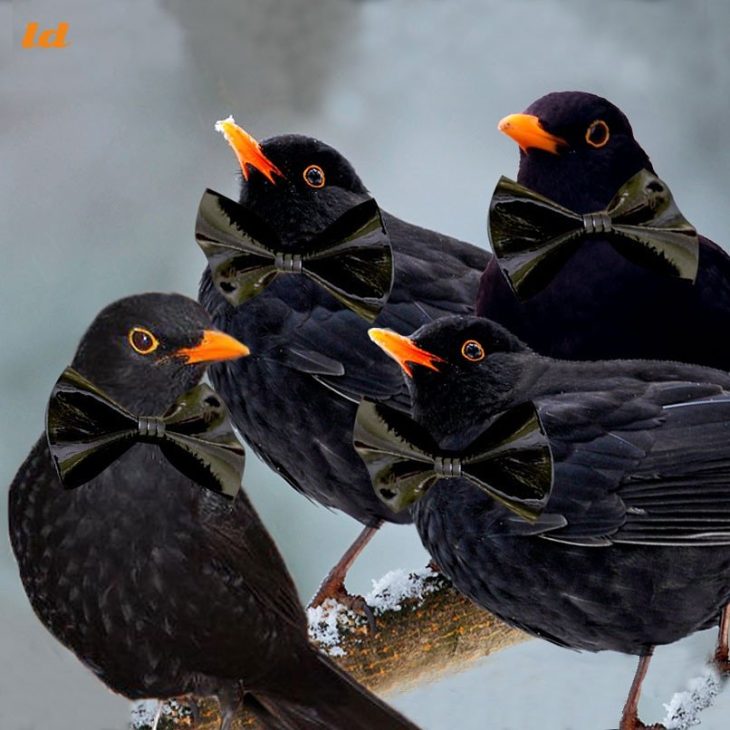
I’m going to stop now, but if you come up with an explanation of why the fourth day brings the gift of colly birds, feel free to share it. But for now, I’m going to go with how resplendent black birds can be.
Today’s image includes this note: “Nancy e. leung on Twitter: ‘four gentlemen colly birds came to calling yesterday… patent leather bowties and all!’” (https://animalia-life.club/qa/pictures/four-colly-birds). These four look as resplendent as my old friend Don Campbell.