Word of the Day: Hogmanay
Today’s word of the day is Hogmanay. Pronounced / ˌhɒg məˈneɪ / (with primary stress on the last syllable and secondary stress on the first syllable), it refers to “the eve of New Year’s Day” or “(lowercase) a gift given on Hogmanay” (https://www.dictionary.com/browse/hogmanay). When I looked up this word on etymonline.com, it gave me the spelling hogmenay, “’last day of December,’ also a refreshment given that day, 1670s, of uncertain origin” (https://www.etymonline.com/word/hogmenay). And that’s it.
Wikipedia has an entry for Hogmanay. It says, “The etymology of the word is obscure. The earliest proposed etymology comes from the 1693 Scotch Presbyterian Eloquence, which held that the term was a corruption of a presumed Ancient Greek: ἁγία μήνη (hagíā mḗnē) and that this meant ‘holy month’. The three main modern theories derive it from a French, Norse or Gaelic root.
The word is first recorded in a Latin entry in 1443 in the West Riding of Yorkshire as hagnonayse. The first appearance in Scots language came in 1604 in the records of Elgin, as hagmonay. Subsequent 17th-century spellings include Hagmena (1677), Hogmynae night (1681), and Hagmane (1693) in an entry of the Scotch Presbyterian Eloquence.
“Although Hogmanay is currently the predominant spelling and pronunciation, several variant spellings and pronunciations have been recorded,” and then it includes a list of spelling variants (https://en.wikipedia.org/wiki/Hogmanay).
It next offers this theory: “The Oxford English Dictionary reports this theory, saying that the term is a borrowing of aguillanneuf (literally ‘To the mistletoe be the new year’) a medieval French cry used to welcome the new year consisting of an unknown first element plus ‘l’an neuf’ (‘the new year’)” (ibid.).
It also offers this: “The word may have come from the Goidelic languages. Frazer and Kelley report a Manx new-year song that begins with the line To-night is New Year’s Night, Hogunnaa but did not record the full text in Manx. Kelley himself uses the spelling Og-u-naa… Tro-la-la whereas other sources parse this as hog-un-naa and give the modern Manx form as Hob dy naa. Manx dictionaries though give Hop-tu-Naa (Manx pronunciation: [hopʰ tθu neː]), generally glossing it as ‘Hallowe’en’, same as many of the more Manx-specific folklore collections” (ibid.). The Goidelic languages are one branch of the Celtic languages, the other being Brittanic. Manx is a Gaelic (or Goidelic) language spoken on the Isle of Man, though it is now considered a heritage language, “learned by its speakers at home as children, and difficult to be fully developed because of insufficient input from the social environment” (https://en.wikipedia.org/wiki/Heritage_language). It nearly died out completely in the 1970s but has since be revitalized.
Some linguists reject the two theories and “instead suggest that the ultimate source for this word’s Norman French, Scots, and Goidelic variants have a common Norse root” (https://en.wikipedia.org/wiki/Hogmanay). “It is suggested that the full forms
- ‘Hoginanaye-Trollalay/Hogman aye, Troll a lay’ (with a Manx cognate Hop-tu-Naa, Trolla-laa)
- ‘Hogmanay, Trollolay, give us of your white bread and none of your gray’
invoke the hill-men (Icelandic haugmenn, compare Anglo-Saxon hoghmen) or “elves” and banishes the trolls into the sea (Norse á læ ‘into the sea’)” (ibid.). I have to admit that this is my favorite of the theories—trolls need to be banished.
“It is speculated that the roots of Hogmanay may reach back to the celebration of the winter solstice among the Norse, as well as incorporating customs from the Gaelic celebration of Samhain. The Vikings celebrated Yule, which later contributed to the Twelve Days of Christmas, or the ‘Daft Days’ as they were sometimes called in Scotland. Christmas was not celebrated as a festival, and Hogmanay was the more traditional celebration in Scotland. This may have been a result of the Protestant Reformation after which Christmas was seen as ‘too Papist’.
“Hogmanay was also celebrated in the north of England, down to and including Richmond in North Yorkshire. It was traditionally known as ‘Hagmena’ in Northumberland, ‘Hogmina’ in Cumberland, and ‘Hagman-ha’ or ‘Hagman-heigh’ in the North Riding of Yorkshire” (ibid.).
On this date in 1600, “Scotland begins its numbered year on January 1 instead of March 25” (https://www.onthisday.com/events/january/1).
When Julius Caesar introduced the Julian calendar in 46 BC (the previous one wasn’t working out that well), he made January 1 the beginning of the new year, in honor of the Roman god Janus, who looks backwards and forwards at the same time (https://www.ancient-origins.net/history-ancient-traditions/march-25-0015100). Prior to that, new years began at a variety of different times around the world.
“In 567 AD the Council of Tours (a Christian NGO comittee) abolished January 1 as the beginning of the year (which no doubt upset Janus a bit, but he didn’t say anything) and they replaced it with March 25, the date of the conception of their Son of God. The day their God came down to walk amongst humanity seemed like a far more appropriate day to have as the start of the year. Logically, if a new year was to be related to a god, in a Christian world it should be related to the Christian god, and so the conception of the Son of God on Earth seems highly appropriate” (ibid.). March 25 is the Feast of the Annunciation, recognizing the day when the Archangel Gabrial announced to Jesus’ mother, Mary, that she would be bearing a son. In a sense, the Feast of the Annunciation might just as well have been called the Feast of the Immaculate Conception, but nobody ever wants to think about that.
But then in 1582, Pope Gregory XIII introduced his revised version of the Julian calendar, called since the Gregorian calender, and Gregory decided (he was the Pope, after all) to make January 1 the beginning of the New Year again. By this time, however, a number of European countries, including England, had rebelled against the Roman Catholic Church and become Protestant, so they were much slower to accept the new calender.
So it took 18 years for the Scots to accept the new and admittedly improved calendar and to make January 1 the beginning of the new year. But that was a lot faster than the American colonies. They didn’t accept December 31 as Hogmanay until 1750.
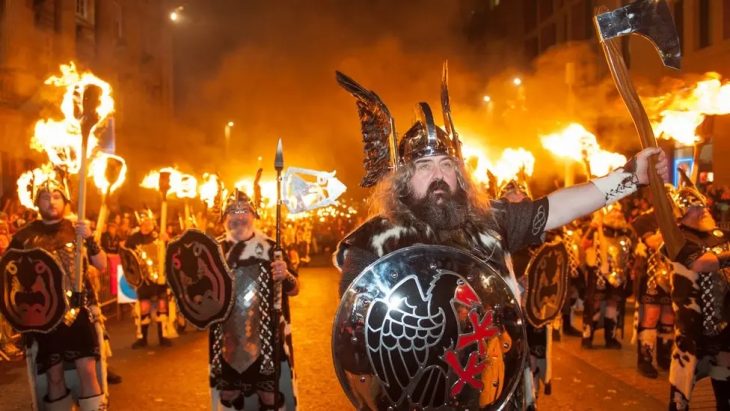
The image today is from a Newsround BBC article from a couple of years ago: “Here we can see men dressed as Vikings taking part in a torchlight procession in Edinburgh as part of Hogmanay celebration” (https://www.bbc.co.uk/newsround/38477036).
Happy Hogmanay everyone; I hope you have a delightful New Year’s Eve celebration, just as we did last night here in Sydney.