Word of the Day: Melioration
Today’s word of the day is melioration. Melioration means “The act or process of improving something or the state of being improved” (https://www.yourdictionary.com/melioration) or “semantic change in a word to a more approved or more respectable meaning” (https://www.dictionary.com/browse/melioration), a term used in historical linguistics, the opposite of which is pejoration.
The word entered the language “c. 1400, melioracioun, ‘improvement, act or process of making or becoming better,’ from Late Latin meliorationem (nominative melioratio) ‘a bettering, improvement,’ noun of action from past-participle stem of meliorare ‘to improve’ (see meliorate). Meliorations in Scottish law were ‘improvements made by a tenant upon rented land’ (https://www.etymonline.com/word/melioration#etymonline_v_44651). It’s interesting that the verb meliorate didn’t enter the language until the “1550s, ‘to make better, improve’ (transitive), a back-formation from melioration or else from Late Latin melioratus, past participle of meliorare ‘improve,’ from Latin melior ‘better,’ used as comparative of bonus ‘good,’ but probably originally meaning ‘stronger,’ from PIE root *mel- ‘strong, great.’ Intransitive sense of ‘to grow better, be improved’ is from 1650s” (ibid.).
You might be more familiar with the word ameliorate, which also means “to make or become better” (https://www.dictionary.com/browse/ameliorate). You might wonder about the prefix a-, which often means “not,” as in atheist or amoral. But in this case the a- is an assimilated form of the Latin prefix ad- “to.” Ameliorate entered the language in the “1650s, … from French amélioration, from Old French ameillorer (12c.)” and comes from the same Latin root as meliorate (https://www.etymonline.com/word/amelioration). It’s a classic case of English borrowing words from other languages at different times even though they mean basically the same thing.
According to the On This Day website, on this date in 1873, “Sultan Bargash bin Said under British pressure closes the infamous slave market of Zanzibar in modern day Tanzania” (https://www.onthisday.com/?utm_source=email&utm_medium=newsletter).
Zanzibar is the name of the archipelago off the coast of Tanzania, in central East Africa, just south of Mombasa, Kenya. It is also what the largest island is sometimes called, though its official name is Unguja. Zanzibar is “an insular semi-autonomous region which united with Tanganyika in 1964 to form the United Republic of Tanzania” (https://en.wikipedia.org/wiki/Zanzibar), and the capital city is Zanzibar City.
Archaeological evidence suggests that humans have lived on Zanzibar for some 20,000 years. It eventually became a hub for trade between the people of Africa and those countries around the Indian Ocean: “Persian, Indian, and Arab traders frequented Zanzibar to acquire East African goods like gold, ivory, and ambergris and then shipped them overseas to Asia. Similarly, caravan traders from the African Great Lakes and Zambezian Region came to the coast to trade for imported goods, especially Indian cloth” (https://en.wikipedia.org/wiki/Zanzibar).
In addition to the trade of goods, Zanzibar was a hub for slave trading. How long the slave trade existed on Zanzibar is impossible to tell (https://en.wikipedia.org/wiki/Slavery_in_Zanzibar#Zanzibar_slave_trade). “During the middle ages, the Zanzibar Archipelago became a part of the Swahili culture and belonged to the Kilwa Sultanate, which was a center of the Indian Ocean slave trade between East Africa and the Arabian Peninsula during the middle ages, and the islands of the Zanzibar Archipelago are known to have traded in ivory and slaves long before it became a part of Oman” (ibid.).
When Zanzibar became part of the Omani Empire, it’s role in the slave trade continued: “Slaves from the Swahili coast was transported via Zanzibar to Oman, and from Oman to Persia and the rest of the Arabian Peninsula and the Middle East. Together, Zanzibar and Oman dominated the Indian Ocean slave trade during the 18th- and 19th-century” (ibid.). Along with cloves and ivory, slaves were one of the three biggest income producers for the Empire. But Zanzibar split from the Omani Empire in 1856.
Slaves were used for a variety of purposes: plantation workers, domestic help, craft artists, and concubines. Female slaves were actually more highly prized than male slaves.
During the 19th century, the British executed several treaties with the Sultanate of Zanzibar to limit the slave trade, but the importation of slaves from the African mainland continued. Finally, in 1873, the British sent a representative named Henry Bartle Frere to negotiate a treaty that would put an end to the slave trade. It didn’t quite succeed because smugglers continued to import slaves into Zanzibar from the African mainland, but the open slave market was closed. And 24 years later, slavery itself was outlawed, again because of pressure from the British.
It took almost the entirety of the 19th century, but eventually Zanzibar went from a center of the African slave trade, particularly to the Middle East, to a land where slaves were able to appeal for their freedom. When I was teaching, I used to ask my students how many had had high school teachers who told them that the world is getting worse and worse, more and more dangerous, and many of them would raise their hands. But the truth is that melioration has occurred throughout the world, including Zanzibar. And while I do not believe in the perfectibility of the human race, I do believe that the world will continue to get better.
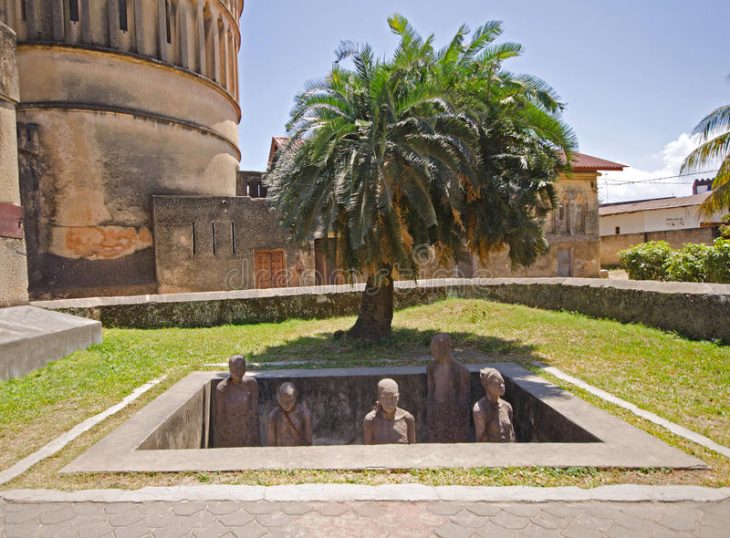
The image today is of a memorial to the enslaved in Stone Town, Zanzibar. The slave market in Stone Town was the last open slave market in the world. An Anglican church was built on the site, but the memorial reminds us of how things used to be (https://wildlifesafaritanzania.com/slave-market-in-stone-town/).