Word of the Day: Bowdlerize
Today’s word of the day, thanks to Words Coach (https://www.wordscoach.com/dictionary), is bowdlerize. Pronounced / ˈboʊd ləˌraɪz / or / ˈbaʊd ləˌraɪz / (so oʊ as in go or aʊ as in mouth), with the primary stress on the first syllable and a secondary stress on the third, this noun means “to expurgate (a written work) by removing or modifying passages considered vulgar or objectionable” (https://www.dictionary.com/browse/bowdlerize). Merriam-Webster has a second, more general definition: “to modify by abridging, simplifying, or distorting in style or content” (https://www.merriam-webster.com/dictionary/bowdlerize).
Etymonline says that the word appears in English in “1836, from the name of Thomas Bowdler, English editor who in 1818 published a notorious expurgated Shakespeare, in which, according to his frontispiece, ‘nothing is added to the original text; but those words and expressions omitted which cannot with propriety be read aloud in a family’” (https://www.etymonline.com/search?q=bowdlerize). But M-W goes into greater depth on the subject: “In 1807, a new edition of the works of William Shakespeare hit the scene in England. Titled The Family Shakespeare, the collection of 20 of the Bard’s plays in four volumes was at first anonymously edited, and promised in its preface to ‘remove every thing that could give just offence to the religious or virtuous mind.’ Though the sanitized project later became a public sensation (and a source of literary derision) after its expanded, ten-volume second edition was published in 1818 and credited solely to physician Thomas Bowdler, the original expurgation was in fact the work of his older sister Henrietta Maria ‘Harriet’ Bowdler, an accomplished editor and author. Within a year of the younger Bowdler’s death in 1825, bowdlerize had come to refer to cutting out the dirty bits of other books and texts—testimony not only to the impact of his eye for impropriety, but to those of his sister Harriet as well, though her efforts were obscured by history, if not technically bowdlerized” (https://www.merriam-webster.com/dictionary/bowdlerize).
Before saying anything about what happened on this date, I do want to digress and talk about the International Phonetic Alphabet. The IPA was developed in the nineteenth century. “The concept of the IPA was first broached by Otto Jespersen in a letter to Paul Passy of the International Phonetic Association and was developed by A.J. Ellis, Henry Sweet, Daniel Jones, and Passy in the late 19th century. Its creators’ intent was to standardize the representation of spoken language, thereby sidestepping the confusion caused by the inconsistent conventional spellings used in every language. The IPA was also intended to supersede the existing multitude of individual transcription systems. It was first published in 1888 and was revised several times in the 20th and 21st centuries. The International Phonetic Association is responsible for the alphabet and publishes a chart summarizing it” (https://www.britannica.com/topic/International-Phonetic-Alphabet). Here is a interactive chart for helping people learn to pronounce English: https://ipachart.app/. The chart includes consonants, vowels and diphthongs. I encourage you to play with it a little.
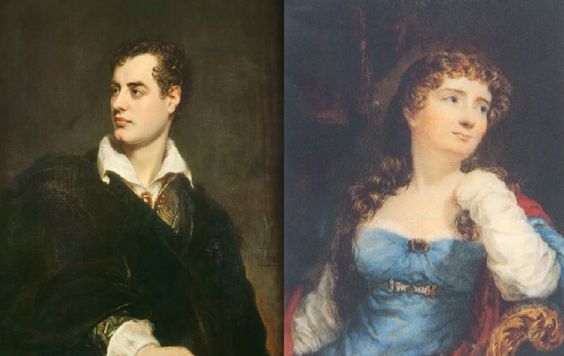
Three days ago was the 2010th anniversary of the official, legal separation of Anna Isabella Noel Wentworth Milbanke and George Gordon Lord Byron (https://exmouth.nub.news/news/local-news/local-historian-exmouths-connection-to-the-wife-of-lord-byron-151007). They had been married roughly one and a half years. And it was a difficult marriage. Byron was having financial difficulties, and he drank heavily, and he was probably abusive, and he cheated on Annabella. In early 1816, he suggested that they, with their infant daughter, move to her parents’ house in Leicestershire. She agreed. She moved while he stayed behind to tie up loose ends, but he never made the move, and they never saw each other again (ibid.).
Lord Byron was described by Lady Caroline Lamb as “mad, bad, and dangerous to know” (ibid.) Rumors spread that he had an incestuous relationship with his half-sister, Augusta Leigh. Although he had become famous and popular from his publication of Childe Harold’s Pilgrimage in 1812, the rumors about his illicit relationship, and his debts, caused him to leave England in April of 1816; he never returned.
Byron lived in several European countries, Switzerland, where he became friends with the Shelleys, Italy, and later Greece, where he became a hero. But it was in Italy where he began writing his mock epic, Don Juan.
The name is pronounced Ju-an, not Hwan as we would normally expect. How do we know? Well, here’s the first verse:
I WANT a hero: an uncommon want,
When every year and month sends forth a new one,
Till, after cloying the gazettes with cant,
The age discovers he is not the true one;
Of such as these I should not care to vaunt,
I’ll therefore take our ancient friend Don Juan. (http://public-library.uk/ebooks/29/77.pdf).
Because it is a mock epic, Byron plays with the conventions of epic poetry. For instance, he begins the third canto with an invocation to the muses which reads, “Hail, Muse, etc.” (ibid.), and then goes on with the tale. He tells us in the beginning of the poem,
Most epic poets plunge ‘in medias res’
(Horace makes this the heroic turnpike road),
And then your hero tells, whene’er you please,
What went before− by way of episode,
While seated after dinner at his ease,
Beside his mistress in some soft abode,
Palace, or garden, paradise, or cavern,
Which serves the happy couple for a tavern.
That is the usual method, but not mine−
My way is to begin with the beginning…. (ibid.)
And because Byron begins at the beginning, he talks about young Juan’s education, including the classics that boys in those days usually studied.
Juan was taught from out the best edition,
Expurgated by learned men, who place
Judiciously, from out the schoolboy’s vision,
The grosser parts; but, fearful to deface
Too much their modest bard by this omission,
And pitying sore his mutilated case,
They only add them all in an appendix,
Which saves, in fact, the trouble of an index;
For there we have them all ‘at one fell swoop,’
Instead of being scatter’d through the Pages;
They stand forth marshall’d in a handsome troop,
To meet the ingenuous youth of future ages,
Till some less rigid editor shall stoop
To call them back into their separate cages,
Instead of standing staring all together,
Like garden gods− and not so decent either. (ibid.)
Despite being part of the Romantic movement of the early 19th century, Byron’s forte was satire, a genre associated more with the Neoclassicals than with the Romantics. Here Byron is clearly making fun of the moralists like Thomas Bowdler, the namesake of bowdlerize.
Today’s image is side-by-side portraits of Lord Byron and Annabella (https://hi-sztori.blog.hu/2024/05/05/annabella_milbanke_aki_kihivas_volt_byron_szamara).