Word of the Day: Abjure
Today’s word of the day, courtesy of the Words Coach (https://www.wordscoach.com/dictionary), is abjure. Pronounced / æbˈdʒʊər / or / æbˈdʒɜr / (I prefer the first pronunciation), this transitive verb means “to renounce, repudiate, or retract, especially with formal solemnity; recant,” “to renounce or give up under oath; forswear,” or “to avoid or shun” (https://www.dictionary.com/browse/abjure).
The word first appears in the English language in the “early 15c., abjuren, ‘renounce on oath, repudiate, forswear,’ originally especially ‘renounce or recant (a heresy) on oath,’ from Old French abjurer and directly from Latin abiurare ‘deny on oath,’ from ab ‘off, away from’ (see ab-) + iurare ‘to swear,’ from ius (genitive iuris) ‘law’ (see jurist)” (https://www.etymonline.com/search?q=abjure). Jurist enters the language in the “mid-15c., ‘one who practices law;’ 1620s, ‘a legal writer, one who professes the science of the law,’ from Old French juriste (14c.), from Medieval Latin iurista ‘jurist,’ from Latin ius (genitive iuris)’”a right,’ especially ‘legal right or authority, law,’ also ‘place where justice is administered, court of justice,’ from Old Latin ious, perhaps literally ‘sacred formula,’ a word peculiar to Latin (not general Italic) that originated in the religious cults, from PIE root *yewes- ‘law’ (Watkins; compare Latin iurare ‘to pronounce a ritual formula,’ Vedic yos ‘health,’ Avestan yaoz-da- ‘make ritually pure,’ Irish huisse ‘just’). Related: Juristic. The more mundane Latin law-word lex meant specific laws as opposed to the body of laws” (https://www.etymonline.com/word/abjure). It is interesting how the two words have sort of switched positions in English over time. The law now can refer to the whole body of laws, whereas a jurist now sits in judgment over someone who may or may not have violated one or more specific laws.
In its “Did You Know” section, Merriam-Webster says, “Just as a jury swears to produce an unbiased verdict, and a witness swears to tell the truth on pain of perjury, those who abjure their former ways ‘swear them away.’ Abjure (as well as jury and perjury) comes from Latin jurare, which means ‘to swear’ (and which in turn is based on the root jus, meaning ‘law’), plus the prefix ab-, meaning ‘away.’ These days, we can casually abjure (that is, abstain from) various vices, but in the 15th and 16th centuries to abjure was a matter of renouncing something under oath—and sometimes a matter of life and death. For example, during the Spanish Inquisition, individuals were given the choice between abjuring unacceptable beliefs and being burned at the stake”( https://www.merriam-webster.com/dictionary/abjure).
On this date in 624, “Muhammad’s Muslim forces win a significant victory over the Meccan army” at the Battle of Badr (https://www.onthisday.com/events/march/13).
Muhammad was born in Mecca to one of the Mecca tribes called the Quraysh. From the age of six, he was raised by his grandfather, who was the tribal leader. As an adult, he began a practice of secluding himself in a cave and praying, and it was during one of these sessions, in 610, that he had his first vision. Three years later, after the angel Gabriel had dictated to him what is now called the Quran, he began preaching and gathering followers to his new religion, although he claimed that it was the culmination of Judaism and Christianity.
But the tribal leaders persecuted Muhammad and his followers. Then, in 622, Muhammad was invited to what is now the city of Medina. “This event, the Hijrah, marks the beginning of the Islamic calendar, also known as the Hijri calendar. In Medina, Muhammad united the tribes under the Constitution of Medina” (https://en.wikipedia.org/wiki/Muhammad). “Although the new Constitution of Medina gave them a modicum of acceptance among the Medinese, the muhājirūn, as Muhammad’s Meccan followers came to be known, remained a separate class, unabsorbed into the socioeconomic fabric of the city. They began raiding caravans whose wares fed Mecca’s merchant economy, while new revelations of the Qurʾān sanctioned aggression against Mecca’s ruling Quraysh tribe for its own aggression against Muhammad’s followers and for its prevention of their worshipping at al-Masjid al-Ḥaram, Islam’s holiest site” (https://www.britannica.com/event/Battle-of-Badr).
“Nearly two years after the Hijrah, in the middle of the month of Ramadan, a major raid was organized against a particularly wealthy caravan escorted by Abū Sufyān, head of the Umayyad clan of the Quraysh. According to the traditional accounts, when word of the caravan reached Muhammad, he arranged a raiding party of about 300, consisting of both muhājirūn and anṣār (Muhammad’s Medinese supporters), to be led by Muhammad himself. By filling the wells on the caravan route near Medina with sand, Muhammad’s army lured Abū Sufyān’s army into battle at Badr, near Medina. There the two parties clashed in traditional fashion: three men from each side were chosen to fight an initial skirmish, and then the armies charged toward one another for full combat. As his army charged forward, Muhammad threw a handful of dust, which flew into the eyes and noses of many of the opposing Meccans. Despite the superior numbers of the Meccan forces (about 1,000 men), Muhammad’s army scored a complete victory, and many prominent Meccans were killed” (ibid.).
If you look for information online about the Battle of Badr, you’ll find many, many sites telling you the lessons of the battle, that it teaches us that we win battles through trust in Allah, that it’s not about the numbers or the weapons. The battle did give the followers of Muhammad the confidence to continue until they eventually defeated the Quraysh and took control of Mecca and then all of Saudi Arabia. Then they continued after Muhammad’s death until they had conquered, in the name of Allah, much of the Middle East and beyond. And it all begins with the Battle of Badr.
Islam describes itself as a religion of peace: “Key verses in the Quran underscore the value of reconciliation and peace, urging Muslims to embrace peace whenever it is offered and to treat all individuals with kindness” (https://explore-islam.com/is-islam-a-religion-of-peace/). But starting in 624 on this date, it seems that a lot of people have abjured the dedication to peace.
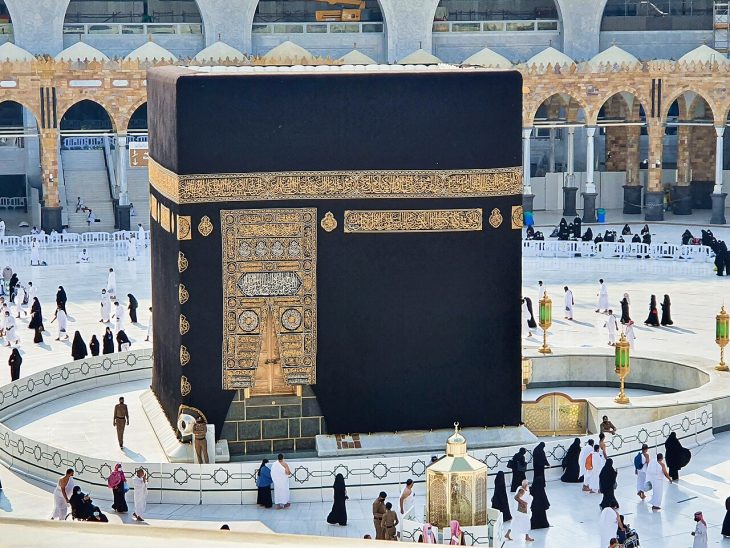
Today’s image is of the Kaaba, a cubical building in Mecca that was originally built, perhaps, by the Quraysh, who were the caretakers of the building until Muhammad took over Mecca. Now it serves as the center of Muslim prayer.