Word of the Day: Punctilious
Today’s word of the day, thanks to the Words Coach (https://www.wordscoach.com/dictionary), is punctilious. Pronounced / pʌŋkˈtɪl i əs /, this adjective means “extremely attentive to punctilios; strict or exact in the observance of the formalities or amenities of conduct or actions” (https://www.dictionary.com/browse/punctilious). Of course, then we have to look up punctilio: it is a noun that means “a fine point, particular, or detail, as of conduct, ceremony, or procedure” or “strictness or exactness in the observance of formalities or amenities” (https://www.dictionary.com/browse/punctilio).
Merriam-Webster elaborates, “A punctilio is a small point—a minor rule, or a little detail of conduct in a ceremony. A person who pays close attention to such minor details is punctilious. Punctiliousness can be valuable, especially for certain kinds of tasks, as long as you don’t become so concerned about small points that you fail to pay attention to the large ones” (https://www.merriam-webster.com/dictionary/punctilious).
The word first appears in English in the “1630s, probably from Italian puntiglioso, from puntiglio ‘fine point,’ from Latin punctum ‘prick’ (from nasalized form of PIE root *peuk- ‘to prick’)” (https://www.etymonline.com/search?q=punctilious). The PIE root “might form all or part of: appoint; appointment; bung; compunction; contrapuntal; expugn; expunge; impugn; interpunction; oppugn; pink; poignant; point; pointe; pointillism; poniard; pounce; pugilism; pugilist; pugnacious; pugnacity; punch (n.1) ‘pointed tool for making holes or embossing;’ punch (n.3) ‘a quick blow with the fist;’ punch (v.) ‘to hit with the fist;’ puncheon (n.2) ‘pointed tool for punching or piercing;’ punctilio; punctilious; punctual; punctuate; punctuation; puncture; pungent; punty; pygmy; repugn; repugnance; repugnant.
“It might also be the source of: Greek pyx ‘with clenched fist,’ pygme ‘fist, boxing,’ pyktes ‘boxer;’ Latin pugnare ‘to fight,’ especially with the fists, pungere ‘to pierce, prick’” (https://www.etymonline.com/word/*peuk-).
This year, 2026, will be the 40th anniversary of one of my favorite films, Ferris Bueller’s Day Off. Written and directed by John Hughes, the master of the teen film, It starred Matthew Broderick, Mia Sara, Alan Ruck, and others. The story is about a high school senior who decides to fake an illness so that he can skip school. He entices his girlfriend and his best friend to join him, and they dodge his sister and the high school principal while enjoying a day out and about in Chicago.
Apparently John Hughes spent the second half of his childhood in Chicagoland, and the city features prominently in the film. “The three visit the Sears Towers observatory, eat lunch at an upscale restaurant, visit the Chicago Stock Exchange, the Art Institute of Chicago, go to a Chicago Cubs baseball game, and attend the Von Steuben Day Parade, where Ferris jumps on a float and lip syncs to ‘Danke Schoen’ by Wayne Newton and ‘Twist and Shout’ by The Beatles” (https://en.wikipedia.org/wiki/Ferris_Bueller%27s_Day_Off).
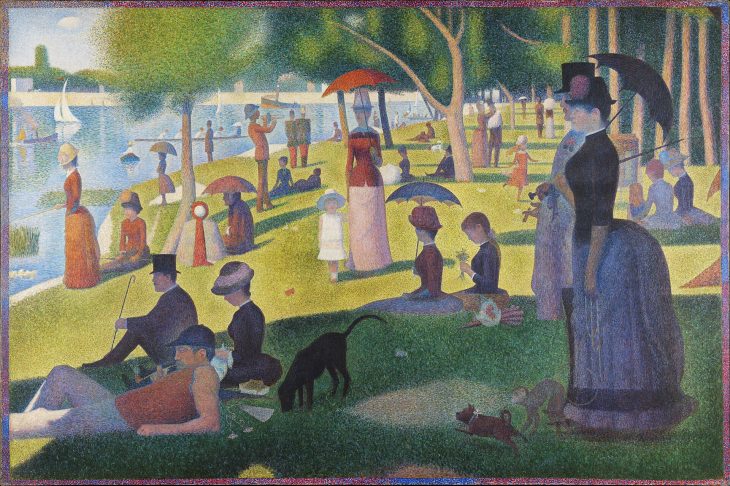
“According to Hughes, the scene at the Art Institute of Chicago was ‘a self-indulgent scene of mine—which was a place of refuge for me, I went there quite a bit, I loved it. I knew all the paintings, the building. This was a chance for me to go back into this building and show the paintings that were my favorite.’ The museum had not been shot in, until the producers of the film approached them. ‘I remember Hughes saying, “There are going to be more works of art in this movie than there have ever been before,”’ recalled Jennifer Grey. Among notable works featured in this scene include A Sunday Afternoon on the Island of La Grande Jatte (Georges Seurat, 1884), during which Cameron struggles to find his identity in the face of one of the children in the painting, and America Windows (Marc Chagall, 1977), in front of which Ferris and Sloane have a romantic moment” (ibid.).
Just a couple of years before Ferris Bueller, Stephen Sondheim and James Lapine produced Sunday in the Park with George, a musical that starred Mandy Patinkin and Bernadette Peters and was directed by Lapine. Parts of it opened Off Broadway in 1983, but the full show opened on Broadway in 1984 at the Booth Theatre. “The plot revolves around George, a fictionalized version of Seurat, who immerses himself deeply in painting his masterpiece, and his great-grandson (also named George), a conflicted and cynical contemporary artist” (https://en.wikipedia.org/wiki/Sunday_in_the_Park_with_George).
“After the failure and scathing critical reception of Merrily We Roll Along in 1981 (it closed after 16 performances), Sondheim announced his intention to quit musical theatre. Lapine persuaded him to return to the theatrical world after the two were inspired by A Sunday Afternoon on the Island of La Grande Jatte. They spent several days at the Art Institute of Chicago studying the painting. Lapine noted that one major figure was missing from the canvas: the artist himself. This observation provided the springboard for Sunday and the production evolved into a meditation on art, emotional connection and community” (ibid.).
It’s interesting that two works of the performing arts were both inspired, at least in part, by a masterpiece of the visual arts, housed as it is in the Chicago Museum of Art. The work of art, A Sunday Afternoon on the Island of La Grande Jatte, by George Suerat, “shows members of each of the social classes participating in various park activities. The tiny juxtaposed dots of multi-colored paint allow the viewer’s eye to blend colors optically, rather than having the colors physically blended on the canvas. It took Seurat two years to complete this 10-foot-wide (3.0 m) painting, much of which he spent in the park sketching in preparation for the work” (https://en.wikipedia.org/wiki/Georges_Seurat).
The work “altered the direction of modern art by initiating Neo-Impressionism, and is one of the icons of late 19th-century painting” (ibid.). The style he used was called pointillism, “a technique of painting in which small, distinct dots of color are applied in patterns to form an image” (https://en.wikipedia.org/wiki/Pointillism). “The technique relies on the ability of the eye and mind of the viewer to blend the color spots into a fuller range of tones. It is related to Divisionism, a more technical variant of the method. Divisionism is concerned with color theory, whereas pointillism is more focused on the specific style of brushwork used to apply the paint” (ibid.).
The style of painting is no longer used by artists, perhaps because it requires a punctilious approach to painting.
Today’s image is from https://en.wikipedia.org/wiki/A_Sunday_Afternoon_on_the_Island_of_La_Grande_Jatte#/media/File:A_Sunday_on_La_Grande_Jatte,_Georges_Seurat,_1884.jpg.
