Word of the Day: Augur
Today’s word of the day is augur. Pronounced / ˈɔ gər /, augur is usually used as a transitive verb meaning “to serve as an omen or promise of; foreshadow; betoken” or “to predict or foretell, as from signs or omens,” or as an intransitive verb meaning “to be a sign of a certain kind of outcome; bode (well, ill, etc.)” or “to make a prediction or guess based on signs or omens” (https://www.dictionary.com/browse/augur). But it can also be used as a noun, meaning “in ancient Rome, any of a group of officials charged with observing and interpreting omens for guidance in public affairs” or “someone who foretells the future and interprets omens; soothsayer or prophet,” and it is sometimes augurer (ibid.).
Merriam-Webster indicates that the noun preceded the verb: “In ancient Rome, augurs were official diviners whose function it was to divine whether the gods approved of a proposed undertaking, such as a military move. They did so by various means, among them observing the behavior of birds and examining the entrails of sacrificed animals. We doubt the Romans predicted that augur would eventuate into a verb meaning ‘presage or foretell,’ but in retrospect, augur’s path must have been in the stars” (https://www.merriam-webster.com/dictionary/augur).
The word appears in English in the “1540s, from Latin augur, a religious official in ancient Rome, perhaps (de Vaan) originally meaning ‘an increase in crops enacted in ritual,’ in which case it probably is from Old Latin *augos (genitive *augeris) ‘increase,’ and is related to augere ‘increase’ (from PIE root *aug- (1) ‘to increase’).
“The more popular theory is that it is from Latin avis ‘bird,’ because the flights, singing, and feeding of birds were important objects of divination (compare auspex). In that case, the second element would be from garrire ‘to talk’” (https://www.etymonline.com/search?q=augur). Etymonline follows that with a quotation from the Century Dictionary: “These auspices were studied, with a fixed ceremonial, in the following classes of phenomena: (1) signs from the heavens, including thunder and lightning, and other meteorological manifestations; (2) signs from the direction of flight or the various cries of birds; (3) signs from the manner of eating of domestic hens kept for this purpose; (4) signs from the movements and attitudes of animals; (5) evil omens from various fortuitous incidents, such as the fall of any object, the gnawing of a mouse, the creaking of a chair, etc., occurring during the augural ceremonies or when these were about to begin” (ibid.).
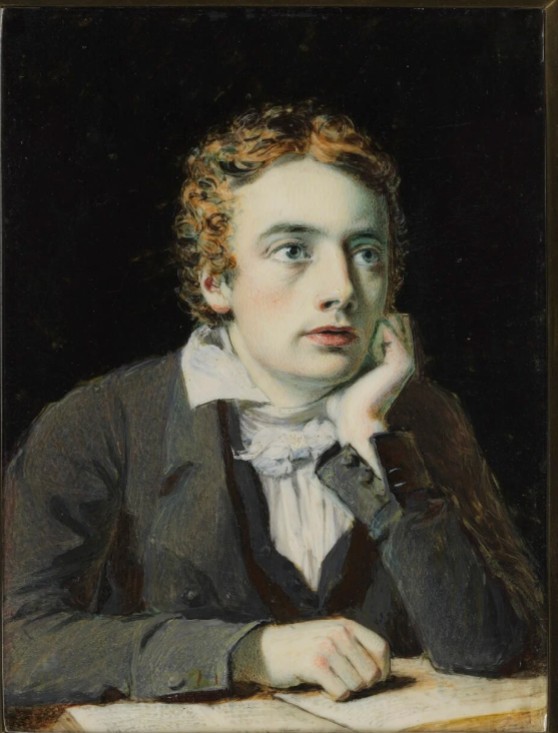
On this date in 1821, the English Romantic poet John Keats died of tuberculosis.
Keats was born to a middle-class family in London in 1795. “In 1803, Keats’ parents sent him to John Clarke’s school in Enfield, which was close to his grandparents’ house and had a more progressive and Guy’s Hospital, but he was never really happy working in the hospital. He wanted to be a poet.
Keats was an admirer of Leigh Hunt and Lord Byron, and he was a friend of Charles Cowden Clarke, who introduced Keats to Leigh Hunt. Hunt published a magazine called The Examiner, and Hunt put Keats’s poem “O Solitude” into his magazine—Keats’s first published poem.
“Upon formally leaving his hospital training in December 1816, Keats’ health took a major hit. He left the damp rooms of London in favor of the village of Hampstead in April 1817 to live with his brothers, but both he and his brother George ended up taking care of their brother Tom, who had contracted tuberculosis. This new living situation brought Keats close to Samuel T. Coleridge, an elder poet of the first generation of Romantics, who lived in Highgate. On April 11, 1818, the two walked together on Hampstead Heath, where they talked about ‘nightingales, poetry, poetical sensation, and metaphysics’” (ibid.).
1818-1819 saw Keats write some of the greatest poems in the English language while taking care of his brother Tom, who was dying of tuberculosis like their mother, and falling in love with Fanny Brawn. But the relationship with Fanny did not turn into a marriage because Keats knew that he would not live long enough. He developed tuberculosis, and despite retiring to Rome for the supposed health benefits, he died of the disease in 1821. “His remains rest in Rome’s Protestant cemetery. His tombstone bears the inscription ‘Here lies One whose Name was writ in Water’” (https://www.thoughtco.com/biography-of-john-keats-poet-4797917).
But his name was not “writ in water”; his name will be remembered for a very long time. He was a great poet, but perhaps not such a good augur. Then again, there is this sonnet:
When I have fears that I may cease to be
Before my pen has gleaned my teeming brain,
Before high-pilèd books, in charactery,
Hold like rich garners the full ripened grain;
When I behold, upon the night’s starred face,
Huge cloudy symbols of a high romance,
And think that I may never live to trace
Their shadows with the magic hand of chance;
And when I feel, fair creature of an hour,
That I shall never look upon thee more,
Never have relish in the faery power
Of unreflecting love—then on the shore
Of the wide world I stand alone, and think
Till love and fame to nothingness do sink.
Today’s image is a portrait of John Keats by Joseph Severn, which now sits in the National Portrait Gallery in London (https://www.npg.org.uk/collections/search/portrait/mw03554/John-Keats).