Word of the Day: Soothsayer
Today’s word of the day is soothsayer. Pronounced / ˈsuθˌseɪ ər /, this noun means “a person who professes to foretell events” (https://www.dictionary.com/browse/soothsayer). I do find it interesting that the definition is not “a person who foretells events,” as if disbelieving the soothsayer goes without saying.
Merriam-Webster, on the other hand, defines it as “a person who predicts the future by magical, intuitive, or more rational means” (https://www.merriam-webster.com/dictionary/soothsayer). M-W goes on to say this: “The origins are straightforward: a soothsayer is someone who says sooth. You may, however, find that less than enlightening! Sooth is an archaic word meaning ‘truth’ or ‘reality’ that dates from Old English and was used until about the first half of the 17th century. (It is believed to share an ancestor with words suggesting truthfulness and reality in Old Norse, Greek, Old High German, Sanskrit, Latin, and Gothic languages.) Soothsayer itself has been documented in print as far back as the 14th century. Today, it is also a moniker of the insect the mantis, whose name means ‘prophet’ in Greek” (ibid.).
It appears in English in the “mid-14c., soth-seier, also zoþ ziggere (Kentish), ‘one who speaks truth, a candid adviser’ (a sense now obsolete); late 14c., sothseggere, ‘fortune-teller, one who claims to foretell the future;’ see sooth + say” (https://www.etymonline.com/word/soothsayer). I won’t bother with the history of say, but here is the history of sooth:
“’truth, reality, fact,’ Old English soð ‘truth, justice, righteousness, rectitude; reality, a true situation, certainty,’ noun use of soð (adj.) ‘true, genuine, real; just, righteous,’ originally *sonð-, from Proto-Germanic *santhaz (source also of Old Norse sannr, Old Saxon soth, Old High German sand ‘true,’ Gothic sunja ‘truth’). Compare forsooth.
“The group is related to Old English synn ‘sin’ and Latin sontis ‘guilty’ (truth is related to guilt via ‘being the one;’ see sin (v.)), from PIE *hes-ont- ‘being, existence,’ thus ‘real, true’ (from present participle of root *es- ‘to be’), also preserved in Latin sunt ‘they are’ and German sind.
“Archaic in English, it is the root of modern words for ‘true’ in Swedish (sann) and Danish (sand). It was in common use until mid-17c. then obsolete until revived as an archaism early 19c. by Scott, etc. It was used for Latin pro- in translating compounds into Old English, such as soðtacen ‘prodigy,’ soðfylgan ‘prosequi’” (ibid.).
On this date in 1921, “Riza Khan Pahlevi seizes control of Iran” (https://www.onthisday.com/events/february/20). Brittanica actually gives the date as February 21, but I suppose the two are pretty close.
The history of Iran, or Persia, is full of somebody seizing control, and it reveals, in a sense, the problem of government. Prior to 1921, Iran had been ruled by the Qajar dynasty since 1789. Prior to that, the nation was ruled by a variety of Muslim governments, first Sunni and then Shi’a. That transition to Islam happened over the course of a couple of centuries after the conquest of Iran by the Rashidun Caliphate in the first half of the seventh century (https://en.wikipedia.org/wiki/Religion_in_Iran). Prior to the conquest, Zoroastrianism was the dominant religion of Iran for almost a thousand years, although Manicheanism was popular, and there were groups of Jews, Christians, and even Buddhists in eastern Iran (ibid.).
The Qajar dynasty was, by the early 20th century, pretty ineffective, at least according to Brittanica: “After centuries of misrule by its former rulers and the ravages of the war waged by foreign belligerents on its soil from 1914 to 1919, Iran in 1921 was prostrate, ruined, and on the verge of disintegration. The last of the shahs of the Qājār dynasty, Aḥmad Shah, was young and incompetent, and the cabinet was weak and corrupt. Patriotic and nationalist elements had long been outraged at the domination of Iran by foreign powers, especially Great Britain and Russia, both of which had strong commercial and strategic interest in the country. This situation led Reza Khan to use the effective and disciplined Persian Cossack Brigade that was at his command to take power and put an end to the chaos. He enlisted some young progressive Iranian elements and also received some encouragement from British diplomats for the endeavor. On February 21, 1921, he occupied Tehrān at the head of 1,200 men. A young journalist, Sayyid Zia al-Din Tabatabaʾi, became prime minister, while Reza Khan took command of all the military forces and was appointed minister of war a few weeks after” (https://www.britannica.com/topic/Pahlavi-dynasty).
Ahmad Shah Qajar, who had replaced his father as Shah when his father was deposed by the Grand Majlis, the Iranian parliament (https://en.wikipedia.org/wiki/Ahmad_Shah_Qajar) remained the monarch, but he was removed by the Majlis in 1925, and Reza Khan Pahlavi was named Shah in his place. Part of the rationale was that Ahmad Shah refused to return to Iran; he had gone into exile in Europe in 1923. He died in Paris in 1930 of the Spanish flu (ibid.).
Reza Khan Pahlavi attempted to modernize Iran. Part of that process was reducing the power of Muslim clerics. But he got into trouble with the West during the 1930s, and in 1941 he was deposed by the Allies for his trade relationship with Nazi Germany. His son, Mohammad Reza Shah Pahlavi, replaced him as monarch.
“Following the war, a loose coalition of nationalists, clerics, and noncommunist left-wing parties, known as the National Front, coalesced under Mohammad Mosaddegh, a career politician and lawyer who wished to reduce the powers of the monarchy and the clergy in Iran. Most important, the National Front, angered by years of foreign exploitation, wanted to regain control of Iran’s natural resources, and, when Mosaddegh became prime minister in 1951, he immediately nationalized the country’s oil industry. Britain, the main benefactor of Iranian oil concessions, imposed an economic embargo on Iran and pressed the International Court of Justice to consider the matter. The court, however, decided not to intervene, thereby tacitly lending its support to Iran” (https://www.britannica.com/topic/Pahlavi-dynasty).
Then in 1953, Pahlavi and Mosaddegh quarreled, and Pahlavi fled the country. But the CIA funded a coup to topple Mosaddegh, and Pahlavi was back as the Shah within a week of his fleeing (ibid.).
Finally, of course, the Ayatollah Khomeini overthrew the Shah in 1979. Life after that coup has not been any better for the people of Iran. In fact, some might say it has gotten considerably worse.
The Pahlavis ruled Iran for about 54 years, and now the Muslim clerics have ruled it for 47. It makes one wonder “what rough beast, its hour come round at last, Slouches towards [Tehran] to be born? (https://www.poetryfoundation.org/poems/43290/the-second-coming). Perhaps a soothsayer could tell us.
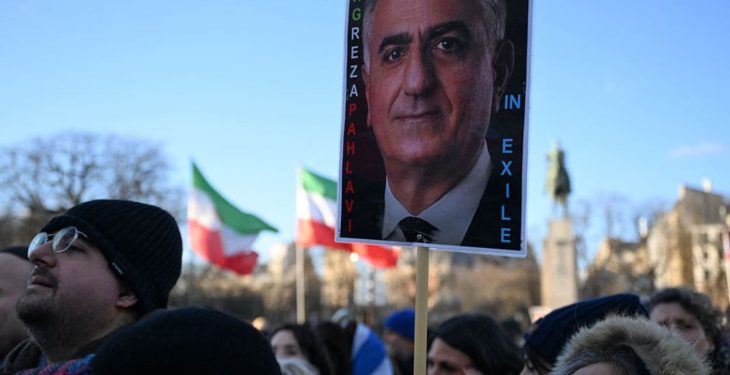
Today’s image: “A PROTESTOR holds a placard of Iranian opposition leader and son of the last Shah of Iran, Reza Pahlavi, during a demonstration against the Iranian regime’s crackdown on protests in central Paris, on January 4, 2026. (photo credit: Blanca CRUZ / AFP via Getty Images)” (https://www.jpost.com/middle-east/iran-news/article-882570). This Reza Pahlavi is the son of the Shah who was deposed in 1979.