Word of the Day: Enchanter
Today’s word of the day, as we continue the series that began with Jim Butcher’s warlock, is enchanter. Pronounced / ɛnˈtʃæn tər / or / ɛnˈtʃɑn tər /, with the emphasis on the second syllable, enchanter refers to “a person who enchants or delights” or “a magician; sorcerer” (https://www.dictionary.com/browse/enchanter).
The word first appears in English “c. 1300, enchauntour, agent noun from enchant, or from Old French enchanteor ‘magician; singer; mountebank,’ from Latin incantatory” (https://www.etymonline.com/search?q=enchanter).
Enchant first appears in the “late 14c., literal (‘practice sorcery or witchcraft on’) and figurative (‘delight in a high degree, charm, fascinate’), from Old French enchanter ‘bewitch, charm, cast a spell’ (12c.), from Latin incantare ‘to enchant, fix a spell upon,’ from in- ‘upon, into’ (from PIE root *en ‘in’) + cantare ‘to sing’ (from PIE root *kan- ‘to sing’). Or perhaps it is a back-formation from enchantment. For sense evolution, compare German besprechen ‘to charm,’ from sprechen ‘to speak’” (https://www.etymonline.com/word/enchant).
Enchantment appears “c. 1300, enchauntement, ‘act of magic or witchcraft; use of magic; magic power,’ from Old French encantement ‘magical spell; song, concert, chorus,’ from enchanter ‘bewitch, charm,’ from Latin incantare ‘enchant, cast a (magic) spell upon,’ from in- ‘upon, into’ (from PIE root *en ‘in’) + cantare ‘to sing’ (from PIE root *kan- ‘to sing’). Figurative sense of ‘allurement’ is from 1670s. Compare Old English galdor ‘song,’ also ‘spell, enchantment,’ from galan ‘to sing,’ which also is the source of the second element in nightingale” (https://www.etymonline.com/word/enchantment).
When I was in high school, I was in the Glee Club. As a part of that we had a smaller group that would go out and perform a capella (without the accompaniment of instruments, not even a piano). This group was called Les Chantours, The Singers. So the magical work of the enchanter must have involved singing, or perhaps chanting, which is a form of singing.
Speaking of enchanters, in this month 49 years ago, Monty Python and the Holy Grail had its first appearance on television, on the CBS Late Movie.
“Monty Python, also known as the Pythons, were a British comedy troupe formed in 1969 consisting of Graham Chapman, John Cleese, Terry Gilliam, Eric Idle, Terry Jones and Michael Palin. The group initially came to prominence in the UK for the sketch comedy television series Monty Python’s Flying Circus, which aired on the BBC from 1969 to 1974. Their work then developed into a larger collection that included live shows, films, albums, books, and musicals; their influence on comedy has been compared to the Beatles’ influence on music” (https://en.wikipedia.org/wiki/Monty_Python).
The Pythons compiled some of their sketches from television into a first movie, entitled And Now for Something Completely Different, in 1971. The Holy Grail was, then, their first movie with an original story, although there is certainly an element of sketch comedy in the film. It also featured the surreal quality that one finds in the television series.
“According to Gilliam, the Pythons turned to rock bands like Pink Floyd and Led Zeppelin for financing because no studio would fund the film, and the rock stars saw it as ‘a good tax write-off’ because the top rate of UK income tax was ‘as high as 90%’ at the time. Idle and Gilliam had previously mentioned that Elton John also contributed to the financing of the film. A 2021 tweet by Eric Idlerevealed that the entire original budget of £175,350 (about $410,000 in 1974) was provided by eight investors: Led Zeppelin (£31,500), Pink Floyd (£21,000), Jethro Tull’s Ian Anderson (£6300), Holy Grail’s co-producer Michael White (£78,750), Heartaches (a cricket team founded by lyricist Tim Rice) (£5,250), and three record companies: Island Records (£21,000), Chrysalis Records (£6,300), and Charisma Records (£5,250), the record label that had released Python’s early comedy albums” (ibid.). It’s actually a bit funny how the big studios missed about as the movie turned out to be one of the most popular films ever made.
The movie was made on a very small budget. The small budget dictated certain aspects of the production, such as the fact that it was filmed almost entirely in Scotland, “particularly around Doune Castle, Glen Coe, and the privately owned Castle Stalker. The many castles seen throughout the film were mainly either Doune Castle shot from different angles or hanging miniatures” (ibid.). John Cleese expressed disappointment with the film’s ending. “’The ending annoys me the most…It ends the way it does because we couldn’t think of any other way’. However, scripts for the film and notebooks that are among Michael Palin’s private archive, which he donated to the British Library in 2017, do document at least one alternative ending that the troupe considered: ‘a battle between the knights of Camelot, the French, and the Killer Rabbit of Caerbannog’. Due to the film’s small production budget, that idea for a ‘much pricier option’ was discarded by the Pythons in favour of the ending with ‘King Arthur getting arrested’, which Palin deemed ‘cheaper’ and ‘funnier’” (ibid.).
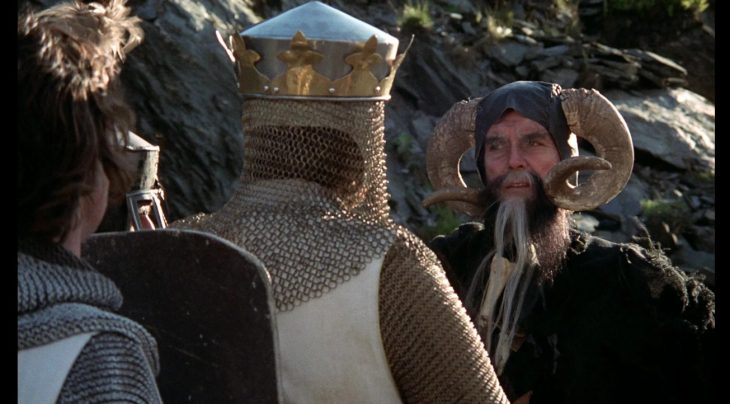
But one of the funniest stories about the filming of Monty Python and the Holy Grail is probably not true. The story goes like this: there’s a scene in which King Arthur and his knights, searching for the Holy Grail, seek advice from an enchanter. When they encounter him (played by John Cleese), he is displaying his skill with fireworks and explosions. Then there is this exchange:
Arthur: “By what name are you known ?”
Tim: “There are some who call me…Tim”
Arthur: “Greetings, Tim, the enchanter.”
https://movies.stackexchange.com/questions/106466/was-tim-the-enchanter-an-ad-libbed-name
The story is the Cleese forget the name, which was supposedly some long Welsh-sounding name, and in a moment of panicked improvisation, he came up with “Tim.” Then Graham Chapman, playing Arthur, went with it, as any good improv artist will do (always say, “Yes, and…”). But why didn’t they reshoot the scene? Because, of course, they were on a tight budget, so they had to keep the improv. Sadly, Cleese himself denied the story, and other people in the industry have said that John Cleese just wasn’t the kind of actor who would improv anything. Furthermore, copies of the script have shown that “Tim” was indeed the original name. The hesitation before the name was not improv, just comedic timing.
Still, it’s a great story, and it makes Tim one of the most memorable names ever for an enchanter. If you have never seen the movie, it’s worth your time, especially if you have a perverse sense of humor.
Today’s image is of John Cleese playing the Enchanter Tim in Monty Python and the Holy Grail (https://fancaps.net/movies/Image.php?imageid=3414293).