Word of the Day: Conjurer
Today’s word of the day, continuing our recent theme, is conjurer. Pronounced / ˈkɒn dʒər ər / (there are other pronunciations suggested, but I think this is the best one), this noun means “a person who conjures spirits or practices magic; magician,” “a person who practices legerdemain; juggler,” or “a person who solemnly charges or entreats” (https://www.dictionary.com/browse/conjurer).
It first appears in English in the “mid-14c., ‘an enchanter, a magician,’ from Anglo-French conjurour, Old French conjureur ‘conjurer, magician, exorcist,’ from the verb or from Latin coniurator, from coniurare (see conjuration)” (https://www.etymonline.com/search?q=conjurer). The verb is “to conjure,” which by magic,” or “to call upon or command (a devil or spirit) by invocation or spell,” or perhaps more mundanely, “to bring to mind; recall (usually followed by up)” or “to appeal to solemnly or earnestly” (https://www.dictionary.com/browse/conjure). The verb form first appears in English in the “late 13c., ‘command on oath;’ c. 1300, ‘summon by a sacred name, invoke by incantation or magic,’ from Old French conjurer ‘invoke, conjure’ (12c.) and directly from Latin coniurare ‘to swear together; conspire,’ from assimilated form of com ‘with, together’ (see con-) + iurare ‘to swear,’ from ius (genitive iuris) ‘law, an oath” (https://www.etymonline.com/search?q=conjure).
We have talked in the past about back formations. Notice how the verb form, which is shorter, appears before the noun form, which is longer, with the agent noun ending -er. While conjurer’s first appearance already shows the meaning of magician, I suspect that it had already been subject to a little bit of broadening since the original sense seems to have been something like, “one who calls forth spirits to do magical stuff.”
On this date in 1895, “Oscar Wilde’s play “Importance of Being Earnest” premieres at St James’s Theatre in London” (https://www.onthisday.com/today/events.php).
Oscar Wilde, born in Dublin in 1854, was the son of Anglo-Irish parents. That means that his parents had English heritage even though they were living in Ireland. It’s actually surprising the number of famous writers who were born and raised in Ireland but eventually moved to London..
Wilde was well known for his involvement in the “aesthetic and decadent movements. He wore his hair long, openly scorned “manly” sports – though he occasionally boxed–and decorated his rooms with peacock feathers, lilies, sunflowers, blue china and other objets d’art. He entertained lavishly and once remarked to some friends, ‘I find it harder and harder every day to live up to my blue china.’ The line spread famously; aesthetes adopted it as a slogan, but it was criticised as being terribly vacuous. Some critics disdained the aesthetes, but their languorous attitudes and showy costumes became a recognisable pose” (https://en.wikipedia.org/wiki/Oscar_Wilde). The aesthetes believed that art should be for the sake of art and not contain lessons.
Although he had written a couple of plays in the 1880s, they were not particularly successful. His novel The Picture of Dorian Gray, however, was. And then, continuing his critique of Victorian society, he returned to the stage with satires of the Victorians. In 1892, his Lady Windermere’s Fan was performed at the St. James Theatre and “was enormously popular, touring the country for months…. The success of the play saw Wilde earn £7,000 in the first year alone (equivalent to £961,500 in 2023)” (ibid.) That was followed the next year by A Woman of No Importance and then by An Ideal Husband in 1894. I have a favorite line from that last one: “I always pass on good advice. It is the only thing to do with it. It is never of any use to oneself.”
The Importance of Being Earnest is the best known of Wilde’s plays. It’s subtitle is, “a Trivial Comedy for Serious People.” Here is plot summary from the His and Her Book Club:
“Jack Worthing has a double life. In the country he is Jack, a respectable guardian to his young ward, Cecily. In London he calls himself Ernest and behaves in a way that would worry any respectable guardian. His friend Algernon Moncrieff suspects something, especially when he finds a mysterious engraving in Jack’s cigarette case.
“Jack is in love with Algernon’s cousin, Gwendolen Fairfax. Gwendolen has decided she can only love a man named Ernest. At the same time, Algernon becomes fascinated by the idea of Jack’s ward and decides to visit the country house under the name Ernest as well.
“Once everyone gathers in the country, both women believe they are engaged to “Ernest”. Lady Bracknell, Gwendolen’s terrifying mother, arrives. A lost handbag, a long-buried family connection, and a few well-timed confessions reveal who Jack really is and why the title of the play is a very smug pun” (https://www.hisandhersbookclub.com/articles/the-importance-of-being-earnest-summary-review).
The play is full of humor, particularly of the verbal kind. Oscar Wilde was nothing if not witty. Here are a few of my favorites:
Lady Bracknell to Jack, who is an orphan: “To lose one parent, Mr. Worthing, may be regarded as a misfortune; to lose both looks like carelessness” (https://www.goodreads.com/work/quotes/649216-the-importance-of-being-earnest).
“The good ended happily, and the bad unhappily. That is what Fiction means” (ibid.).
“I hope you have not been leading a double life, pretending to be wicked and being good all the time. That would be hypocrisy” (ibid.).
“If I am occasionally a little over-dressed, I make up for it by being always immensely over-educated” (ibid.).
“To be natural is such a very difficult pose to keep up” (ibid.).
“I do not approve of anything that tampers with natural ignorance. Ignorance is like a delicate exotic fruit; touch it and the bloom is gone. The whole theory of modern education is radically unsound. Fortunately in England, at any rate, education produces no effect whatsoever” (ibid.).
Jack (or Ernest), after he finds out that his name really is Ernest: “Gwendolen, it is a terrible thing for a man to find out suddenly that all his life he has been speaking nothing but the truth. Can you forgive me?” (ibid.).
There are many more, but I’ll stop here. I’ll just say that one has to wonder if Wilde was inventing such witty repartee or conjuring it. If you’ve never seen Earnest, do so if you get the chance. And look for An Ideal Husband as well, or at least look for videos of them.
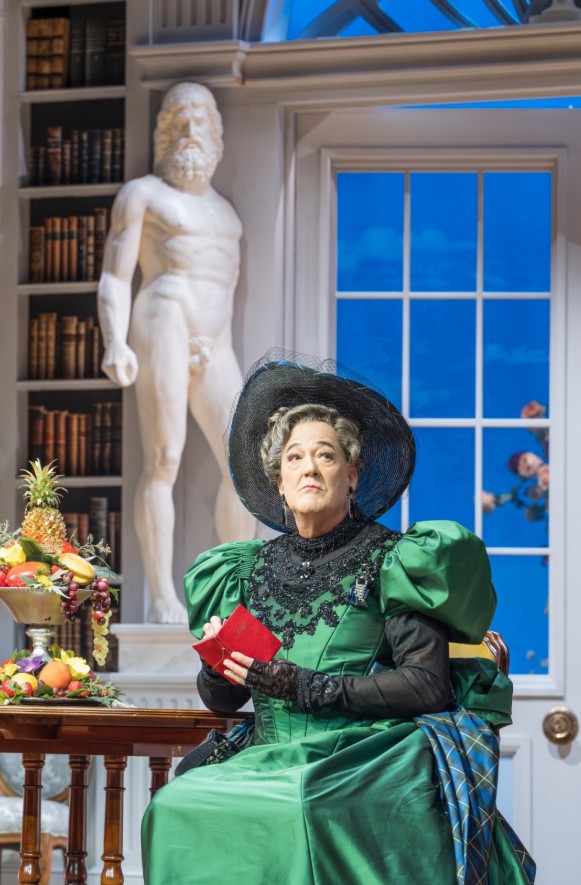
The image today is from a recent revival of The Importance of Being Earnest in London, starring Stephen Fry as Lady Bracknell (https://www.westendtheatre.com/310485/news/show-photos/the-importance-of-being-earnest-west-end-photos-videos-starring-stephen-fry-olly-alexander/).