Word of the Day: Sorcerer
Today’s word of the day continues the theme from the past few days with sorcerer. This noun, pronounced / ˈsɔr sər ər /, means “a person who practices sorcery; black magician; wizard” (https://www.dictionary.com/browse/sorcerer). Now, I think I have mentioned that it’s annoying when a word is defined in terms of a very similar term, but that is what we have here. So here is the definition of sorcery: “the art, practices, or spells of a person who is supposed to exercise supernatural powers through the aid of evil spirits; black magic; witchery” (https://www.dictionary.com/browse/sorcery).
So a sorcerer is someone who deals specifically with black magic. That makes them different from a wizard or even a witch.
The word first appears in English in the “early 15c., ‘conjurer of spirits, one who uses magic arts in divination,’ an extended form of earlier sorcer (late 14c.), which is from Old French sorcier, from Medieval Latin sortarius ‘teller of fortunes by lot; sorcerer’ (also source of Spanish sortero, Italian sortiere; see sorcery).
“With superfluous -er, as in poulterer, upholsterer, caterer, sophister. Sorcerer also might be back-formed from sorcery, or influenced by it.
“Always with more or less a suggestion of evil. Sorcerer’s apprentice as a figure of one who unleashes forces he cannot control translates l’apprenti sorcier, title of a symphonic poem by Paul Dukas (1897) based on a Goethe ballad (‘Der Zauberlehrling,’ 1797), but the common figurative use of the term in English (1952) arises only after Disney’s ‘Fantasia’ (1940)” (https://www.etymonline.com/search?q=sorcerer).
We have talked before about back formations, when a shorter form of a word is derived, by analogy, from a longer form of a word. In this case sorcer, without the superfluous -er, is derived from sorcery.
On this date in 1554, “Queen of England for nine days, Lady Jane Grey aged about 17 is executed for treason under Mary I at the Tower of London” (https://www.onthisday.com/today/events.php).
Henry VIII was, of course, the second Tudor king of England and the one who first took England out of the Roman Catholic Church. He is most famous for having had six wives, the first of whom was the Roman Catholic Katherine of Aragon. After that, the other queens were Protestant in large part because the Pope would not grant Henry a divorce.
Henry had three children: Mary, daughter of Catherine of Aragon, Elizabeth, daughter of Anne Boleyn, Henry’s second wife, and Edward, son of Jane Seymour, Henry’s third wife. When Henry died in 1547, Edward was crowned king even though Edward was only nine years old. Edward was, apparently, very religious for such a young person, and very Protestant. Then, in 1553, Edward became very sick, and because he was concerned that his older stepsister, Mary, was a Roman Catholic, he wanted to change the succession. But he was advised that he couldn’t remove Mary from the line of succession without also removing Elizabeth, his other stepsister. So Edward removed both sisters from the line of succession using what by then had become the old standard, that they were illegitimate.
So Edward created a devise that named Jane Grey his successor.
“Jane received a humanist education from John Aylmer, speaking Latin and Greek from an early age, also studying Hebrew with Aylmer and Italian with Michelangelo Florio. She was particularly fond, throughout her life, of writing letters in Latin and Greek. Through the influence of her father and her tutors, she became a committed Protestant and also corresponded with the Zürich reformer Heinrich Bullinger. Jane had a reputation as one of the most learned young women of her day” (https://en.wikipedia.org/wiki/Lady_Jane_Grey).
But after initially accepting Edward’s change of the line of succession, and after Lady Jane Grey had been crowned queen, the Privy Council and the other peers decided that Mary really did need to be made queen. Part of Mary’s support came from the Roman Catholic community that had gone a little underground, but part of it was Protestant, and one has to wonder why Protestant lords would have supported Mary. I think part of the reason is out of the fear that such a disregard of the hierarchy of inheritance could spell bad news for their own ability to inherit and pass on their own lands and titles.
Unfortunately for Lady Jane, this change led to her losing her throne after only nine days (she is sometimes called the “Nine Days Queen”). She, her husband, and some of the people around her were charged with treason, tried, and sentenced to death. Initially, Mary postponed her execution, but after Wyatt’s Rebellion in 1554, Mary decided that Jane could be a lightning rod for future rebellions, and that she had to die.
Before her execution, she said to the people assembled in the Tower Green, “Good people, I am come hither to die, and by a law I am condemned to the same. The fact, indeed, against the Queen’s highness was unlawful, and the consenting thereunto by me: but touching the procurement and desire thereof by me or on my behalf, I do wash my hands thereof in innocency before God and the face of you Christian people, this day” (ibid.).
I think the one thing about Jane’s story that surprises me (mostly it saddens me) is that she was not accused of being a sorcerer. After all, intelligent and educated women in days gone by were often accused of engaging in the dark arts.
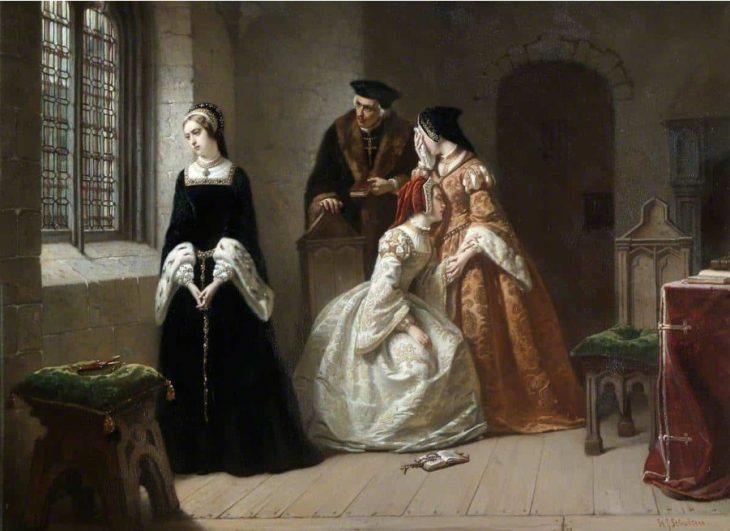
Today’s image is The Last Moments of Lady Jane Grey by Hendrick Jacobus Scholten, Amsterdam, 19th century (https://historycollection.com/10-tragic-details-in-the-death-of-the-nine-days-queen-lady-jane-grey/).