Word of the Day: Beleaguer
Today’s word of the day, courtesy of the Words Coach (https://www.wordscoach.com/dictionary), is beleaguer, which the Words Coach website defines as “annoy persistently.” Pronounced / bɪˈli gər /, with the stress on the second syllable, the verb means “to surround with military forces” or “to surround or beset, as with troubles” (https://www.dictionary.com/browse/beleaguer).
Merriam-Webster, in its “Did You Know?” section, says this: “There’s no getting around it: beleaguer is a ‘troubling’ word. It comes from the Dutch verb belegeren, which in turn combines leger, meaning ‘camp,’ and the prefix be- (a relative of the English be- meaning ‘about’ or ‘around’). While the Dutch word, meaning ‘to camp around,’ is neutral, its descendent beleaguer implies a whole heap of fuss and bother. Beleaguer was first used in the late 16th century, and is still used today, as a synonym of besiege; indeed, an army beleaguering or besieging a castle may also be said to be ‘camping around’ it, albeit with nefarious rather than recreational purposes. This sense of beleaguer was almost immediately joined, however, by its now more common—and less martial—meaning of ‘to cause constant or repeated trouble for’” (https://www.merriam-webster.com/dictionary/beleaguer).
Beleaguer entered the language in the “1580s, ‘besiege, surround, blockade,’ literal and figurative, from Dutch or Low German belegeren ‘to besiege,’ from be- ‘around’ (from Proto-Germanic *bi- ‘around, about;’ see by) + legeren ‘to camp,’ from leger ‘bed, camp, army, lair,’ from Proto-Germanic *legraz- (from PIE *legh-ro-, suffixed form of root *legh- ‘to lie down, lay’). A word from the Flemish Wars (cognates: Swedish belägra, Dutch belegeren ‘besiege,’ German Belagerung ‘siege’). The spelling influenced by unrelated league” (https://www.etymonline.com/search?q=beleaguer). That spelling already exists by 1708, where it can be found in John Kersey’s Dictionarium Anglo-Brittanicum or a more compleat Universal Etymological English Dictionary than any extant (https://www.lexilogos.com/english/english_modern_early.htm).
On this date in 1921, Agatha Christie’s first detective novel, The Mysterious Affair at Styles, was published by The Bodley Head in the UK. It had already been published in the USA by John Lane in October of 1920 (https://www.onthisday.com/events/january/21).
Agatha Christie was born Agatha Miller in 1890 to an upper middle class in Torquay, in Devon, in the UK (https://en.wikipedia.org/wiki/Agatha_Christie#cite_ref-film_28-1). Her father was actually an American, and he homeschooled Agatha when she was young. She did have two older siblings, but they were 10 and 11 years older (https://www.agathachristie.com/about-christie). Her mother, Clara, took her to France to a succession of boarding schools, where she learned piano, among other things. “At the age of 18 Agatha was already amusing herself writing short stories, which Clara had suggested she do to stave off boredom while in bed with influenza” (https://www.agathachristie.com/about-christie).
“Clara’s health and the need for economies dictated their next move. In 1910 they set off for Cairo and a three month debutante season at the Gezirah Palace Hotel. Marriage was the main goal for young women, and the girls were on the lookout for handsome men to flirt with. There were evening dresses and parties, and young Agatha showed more interest in these than the local archaeological sites. Friends she made in Cairo invited her to house parties back home on her return and various marriage proposals followed. Most were rejected, but she warmly accepted the hand of her friend Reginald Lucy. Reggie, ever practical, insisted however that they wait for two years – and should anyone else richer come along in the meantime then Agatha was free to break off the engagement” (ibid.). And eventually she did break off the engagement in order to marry Archie Christie.
What is odd about the marriage is that it occurred in late 1914, and Christie was fighting in France while Agatha was working as a nurse back in England. They saw each other rarely during those four years. But she did see refugees from Europe, particularly from Belgium, and she learned a good bit about pharmaceuticals. That experience led to the writing of her first detective novel, starring a Belgian detective living in England, and featuring poison as the murder weapon (ibid.).
I’m not going to reveal anything about the plot; if you haven’t read it, you should. It is a prime example of the Golden Age of Detective Fiction. And Christie was the Queen of Mystery. “The novel’s review in The Sunday Times of 20 February 1921, quoted the publisher’s promotional blurb concerning Christie writing the book as the result of a bet that she would not be able to do so without the reader being able to guess the murderer, then said, ‘Personally we did not find the “spotting” so very difficult, but we are free to admit that the story is, especially for a first adventure in fiction, very well contrived, and that the solution of the mystery is the result of logical deduction. The story, moreover, has no lack of movement, and the several characters are well drawn’” (https://en.wikipedia.org/wiki/The_Mysterious_Affair_at_Styles).
Christie had read Wilkie Collins and Sir Arthur Conan Doyle, so it’s not surprising that her style of mystery is like that, with a logically minded detective with a side kick who stands in, as it were, for the reader (compare Sherlock Holmes and Dr. Watson). Her legacy includes all the cozy mysteries that get published every month, as well as movies and TV shows, like the recent Netflix series, The Seven Dials Mystery.
Some people call Christie the most published novelist in history. I don’t know how that is determined, but it certainly is an interesting claim. She was enormously successful. But that doesn’t mean she lived life without ever being beleaguered. But her personal difficulties (her marriage ended poorly) did not prevent her from becoming a household name.
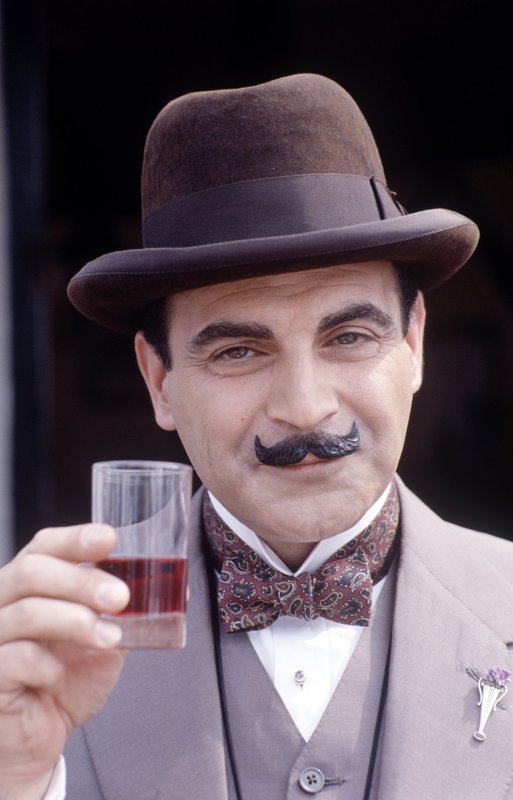
Today’s image is of a movie version of Hercule Poirot, the detective in The Mysterious Affair at Styles. The actor is David Suchet (https://www.fernsehserien.de/agatha-christies-poirot/folgen/3×05-das-wespennest-124577).