Word of the Day: Yule
Today’s word of the day, thanks to the season, is yule. Pronounced / yul /, this noun means “Christmas, or the Christmas season” or “an ancient Germanic pagan holiday centering around the winter solstice, now sometimes celebrated by neopagans” (https://www.dictionary.com/browse/yule). Merriam-Webster says, “the feast of the nativity of Jesus Christ” (https://www.merriam-webster.com/dictionary/yule).
The word appears in the language in its more-or-less current form as “Middle English Yol, from Old English geol, geola ‘Christmas Day, Christmastide,’ which is cognate with Old Norse jol (plural), the name of a heathen feast, later absorbed into Christianity. The Germanic word is of unknown origin.
“The Old English (Anglian) cognate giuli was the name for a two-month midwinter season corresponding to Roman December and January, a time of important feasts but not itself a festival.
“In Christian England the word narrowed to mean ‘the 12-day feast of the Nativity’ (which began Dec. 25). But by 11c. it was replaced by Christmas, except in the northeast (areas of Danish settlement), where yule remained the usual word. Yule returned to literary use among 19c. writers with a sense of ‘the Christmas of “Merrie England.”’
“Yule log and yule block both are from mid-17c. According to some sources, Old Norse jol was borrowed into Old French as jolif, hence Modern French joli ‘pretty, nice,’ originally ‘festive’ (see jolly)” (https://www.etymonline.com/search?q=yule).
One more thing: the tide of “Christmastide” or “yuletide” has nothing to do with the sea or the moon. It too appears as “Middle English tide ‘time, season; recurring interval, space of time,’ especially as regards a particular purpose or natural process, from Old English tīd ‘point or portion of time, due time, period, season; feast-day, canonical hour,’ from Proto-Germanic *tīdi- ‘division of time’ (source also of Old Saxon tid, Dutch tijd, Old High German zit, German Zeit ‘time’), according to Watkins from PIE *di-ti- ‘division, division of time,’ suffixed form of root *da- ‘to divide.’
“The ‘time’ senses in English mostly are archaic. Compare tidings, betide, tidy (adj.), also Middle English anytide ‘any time,’ tideful ‘seasonable, opportune, timely, fitting’ (c. 1300). Old English uhtan-tid was early morning, the period before dawn (with uhte ‘daybreak’); tide-song was the divine service peculiar to a canonical hour” (https://www.etymonline.com/search?q=tide).
There’s an old expression, “Time and tide wait for no man,” that seems to confuse some people. It also has nothing to do with the sea or with the moon. But it is somewhat redundant, with tide meaning, perhaps, “divisions of time” if not just time. Redundancy in old expressions is not uncommon.
It’s New Year’s Eve, December 31. I’m not one to celebrate New Year’s Eve, really, but this year might be different.
First, why don’t I celebrate New Year’s Eve? People do several things for this holiday: they do fireworks, they make resolutions, and they drink champagne. I don’t really care about fireworks that much after seeing them for almost 70 years. The main thing that resolutions do is get broken. And while I can drink champagne, I wouldn’t call it my favorite. I do like kissing my wife at the stroke of midnight, though that will not be happening this year.
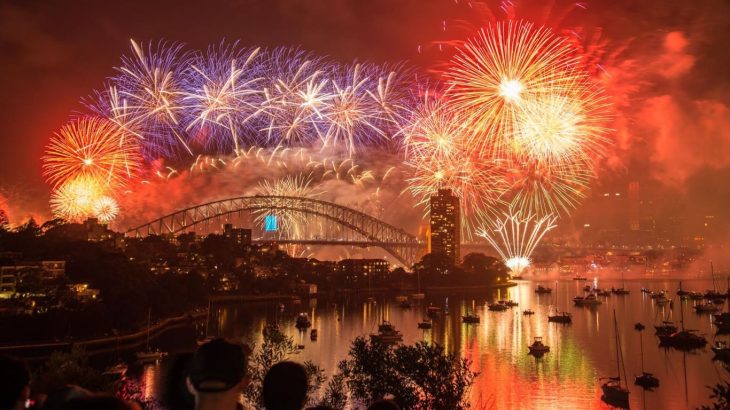
The reason that won’t be happening this year is that I’m in Australia. I’m in Adelaide for a wedding, but later we’ll be travelling to Sydney, where New Year’s Eve is apparently, from what I’ve read, a really big thing. Australian Vibes (https://ausvibes.com.au/how-australians-celebrate-new-year-traditions-events-summer-lifestyle/) says that “Sydney’s New Year’s Eve celebration is often described as one of the best in the world.”
“What makes Sydney special:
Fireworks over Sydney Harbour Bridge and Opera House
Early evening fireworks for families
Harbour cruises and ticketed events
Global media coverage.”
You might wonder how that is different from New York City, which also features global media coverage. Well, according to Australian Vibes, one of the big differences is that it’s summertime down under, so New Year’s Eve “is deeply connected to beach culture, outdoor living, and community events” (ibid.). The holiday includes school being out for the summer, a time for families to go on vacation and travel, and warmth. “Summer in Australia is festival season, and New Year often coincides with: Outdoor music festivals; Beachside concerts; Food and wine events; Cultural celebrations” (ibid.).
There is even a website devoted exclusively to the Sydney New Year’s Eve: “A New Year’s Eve Like Nowhere Else” (https://www.sydneynewyearseve.com/).
What am I doing New Year’s, New Year’s Eve? Well, I don’t know yet, but I’ll be down under for the rest of the Yule tide.
Today’s image is a file photo from Travel and Leisure of Sydney harbor on New Year’s Eve.