Word of the Day: Elf
Today’s word of the day, thanks to the Dictionary Project (https://www.dictionaryproject.org/), is elf. Pronounced / ɛlf /, this noun means “(in folklore) one of a class of preternatural beings, especially from mountainous regions, with magical powers, given to capricious and often mischievous interference in human affairs, and usually imagined to be a diminutive being in human form; sprite; fairy,” “a diminutive person, especially a child,” or “a mischievous person, especially a child” (https://www.dictionary.com/browse/elf).
The word in English goes all the way back to “Old English elf (Mercian, Kentish), ælf Northumbrian), ylfe (plural, West Saxon) ‘sprite, fairy, goblin, incubus,’ from Proto-Germanic *albiz (source also of Old Saxon alf, Old Norse alfr, German alp ‘evil spirit, goblin, incubus’), origin unknown; according to Watkins, possibly from PIE *albho- ‘white.’ Used figuratively for ‘mischievous person’ from 1550s.
“In addition to elf/ælf (masc.), Old English had parallel form *elfen (fem.), the plural of which was *elfenna, -elfen, from Proto-Germanic *albinjo-. Both words survived into Middle English and were active there, the former as elf (with the vowel of the plural), plural elves, the latter as elven, West Midlands dialect alven (plural elvene).
“The Germanic elf originally was dwarfish and malicious (compare elf-lock ‘knot in hair,’ Old English ælfadl ‘nightmare,’ ælfsogoða ‘hiccup,’ thought to be caused by elves); in the Middle Ages they were confused to some degree with faeries; the more noble version begins with Spenser. Nonetheless a popular component in Anglo-Saxon names, many of which survive as modern given names and surnames, such as Ælfræd ‘Elf-counsel’ (Alfred), Ælfwine ‘Elf-friend’ (Alvin), Ælfric ‘Elf-ruler’ (Eldridge), also women’s names such as Ælfflæd ‘Elf-beauty.’ Elf Lock hair tangled, especially by Queen Mab, ‘which it was not fortunate to disentangle’ [according to Robert Nares’ glossary of Shakespeare] is from 1592” (https://www.etymonline.com/search?q=elf).
I got the news this morning that Brigitte Bardot died yesterday. She was 91. When I was young, she was a big, big star, especially in France but also in the USA. Born in 1934, she married the French director/writer/producer Roger Vadim in 1950 (do the math). By 1952, she was making movies, the most famous and scandalous of which was the 1956 film And God Created Woman, by Vadim (note: Vadim was also married to Jane Fonda from 1965 to 1973; together they did Circle of Love in 1964, in which Fonda became on of the first American movie stars to appear nude). She was one of a trio of “sex symbols” in the 50s and 60s, the others being Sophia Loren and Raquel Welch. They were different from the pin-up girls of the previous generation in that they often played sexually liberated women, which is why And God Created Woman was actually banned in a number of states in the USA.
Like most American kids, I was aware of Brigitte Bardot, but her career ended when she retired from making movies in 1973, and I was too young to have seen any of her movies, especially since there was no VCR or DVD. So I cannot say that I was a fan. But I was a fan of a movie about Brigitte Bardot, called Dear Brigitte.
Adapted from a 1963 novel Erasmus with Freckles by John Haase, Dear Brigitte was released in 1965. The movie starred Jimmy Stewart, Glynis Johns, the wonderful character actor Ed Wynn, the 60s teen idol Fabian, and 10-year-old Billy Mumy. Stewart plays a liberal arts professor at a university in San Francisco. Professor Leaf, who also writes poetry, is determined to have an artistic family—they even have a family band. He also reveals unhappiness that American higher education is becoming more focused on the sciences than on the arts.
Leaf notices that someone in the family band (himself, wife, teenage daughter, and young son) isn’t playing the right notes in the band. It turns out that his son is tone deaf. But young Erasmus does turn out to be a mathematics savant. They figure this out in a bank—young Erasmus points out an error by the bank, the bank manager says that Erasmus cannot possibly be right, and then Erasmus is proven correct.
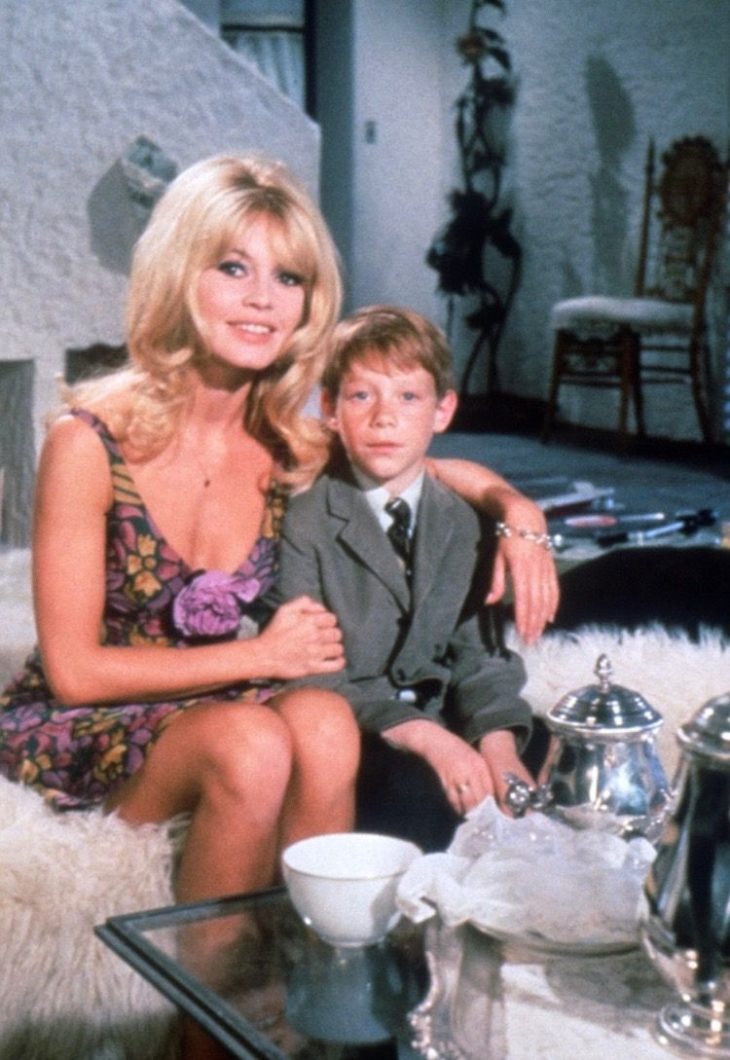
The twist comes when it turns out that the older sister and her friends and getting Erasmus to do their homework and helping them with some at-the-time illegal gambling. There’s a psychologist who gets included in the comedy, and through the psychologist it turns out that Erasmus’s obsession is not mathematics or gambling but Brigitte Bardot. Late in the movie Erasmus and Leaf go to Paris and actually meet Bardot; her appearance in the film as herself is uncredited, and you won’t find it in the Wikipedia filmography.
There are several things about this movie that I really like. First, Leaf and his family live on a houseboat. To this day I think it would be very cool to live on a houseboat. Second, I loved Stewart’s portrayal of an eccentric professor. I never was eccentric the way Steward was when I was a professor. Third, I appreciated the professor’s defense of the liberal arts.
Finally, seeing the young elf played by Billy Mumy meeting his idol, Bardot, is a neat moment.
I encourage you to watch Dear Brigitte. Here’s a link to watching it on YouTube: https://www.youtube.com/watch?v=iJWgD4vY6II. It’s not exactly a classic, although one might argue that any movie with Jimmy Stewart is.
And today’s image is from the movie (https://au.pinterest.com/pin/with-billy-mumy-in-the-film-dear-brigitte-1965-brigittes-first-and-only-american-film-and-her-scenes-were-shot-from-paris–40532465385393993/).