Word of the Day: Bailiwick
Today’s word of the day, courtesy of Word Guru’s daily email, is bailiwick. Pronounced / ˈbeɪ ləˌwɪk / (although I have heard many people pronounce it more like / ˈbeɪ liˌwɪk / despite the fact that the second syllable receives no stress and, as we all know, in English, vowels in unstressed syllables tend toward schwa), this noun means “the district within which a bailie or bailiff has jurisdiction” or “a person’s area of skill, knowledge, authority, or work” (https://www.dictionary.com/browse/bailiwick).
Merriam-Webster says the following to explain bailiwick: “The first half of the word bailiwick comes from the Middle English word for ‘bailiff’—in this case, a term referring to a sheriff or chief officer of a town in medieval England, not the officer who assists today in U.S. courtrooms. Bailiff comes, via Anglo-French, from the Medieval Latin verb bajulare, meaning ‘to care for’ or ‘to support.’ The second half of bailiwick comes from wik, a Middle English word for ‘dwelling place’ or ‘village,’ which ultimately hails from the Latin word vicus, meaning ‘village.’ (This root is also thought to have given English -wich and -wick, suffixes used in place names like Norwich and Warwick.) Although bailiwick dates from the 15th century, the ‘special domain of knowledge’ sense we use most often today did not appear in English until the middle of the 19th century” (https://www.merriam-webster.com/dictionary/bailiwick).
The word enters the English language in the “mid-15c., ‘district of a bailiff, jurisdiction of a royal officer or under-sheriff,’ a contraction of baillifwik, from bailiff (q.v.) + Middle English wik, from Old English wic ‘village’ (see wick (n.2)). The figurative sense of ‘one’s natural or proper sphere’ is by 1843” (https://www.etymonline.com/search?q=bailiwick).
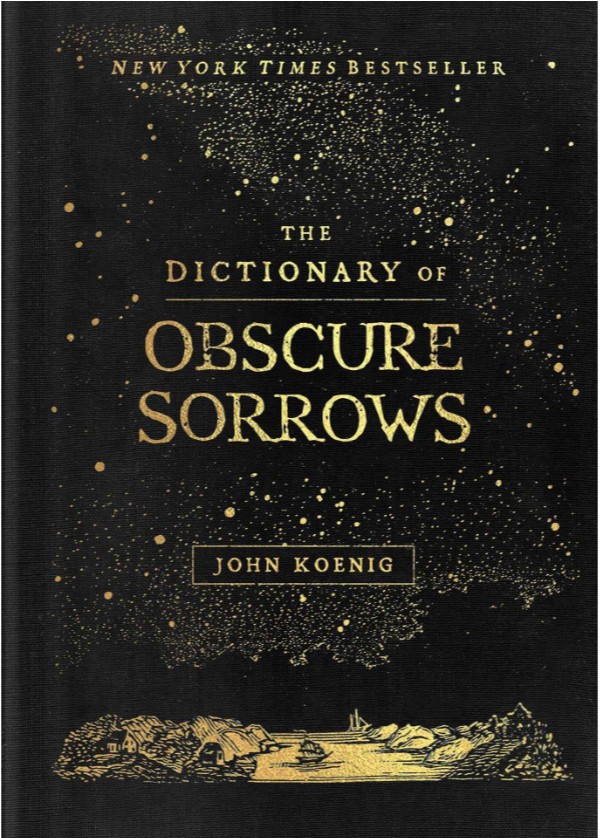
I listen to a number of podcasts, and one of them is called Lexicon Valley (https://lexiconvalley.supportingcast.fm/). It used to be hosted by John McWhorter, a professor of linguistics at Columbia University. Before that, it was hosted by Mike Vuolo, the founder of Booksmart Studios, and Bob Garfield, a journalist and columnist, and since McWhorter has stepped away from the show a few months ago, Vuolo and Garfield are once again the hosts. Today’s show featured an interview with John Koenig, creator of the website and YouTube channel “The Dictionary of Obscure Sorrows,” and the author of a book by the same name.
Koenig says in the interview that when he was a senior in college he was writing a poem and the idea of “obscure sorrows” came to him. “The Dictionary of Obscure Sorrows was the idea he came up with that would contain all the words he needed for his poetry, including emotions that had never been linguistically described” (https://en.wikipedia.org/wiki/The_Dictionary_of_Obscure_Sorrows). “The entries include extensive constructed etymologies based on Koenig’s own research on linguistics, with roots and suffixes taken from Latin, Germanic, and Ancient Greek sources in emulation of existing English terms. The website includes verbal entries in the style of a conventional dictionary, and the YouTube channel picks some of those words and tries to express their meaning more thoroughly in the form of video essays. The book takes from those previous formats, so it has both dictionary style entries and some longer essays on specific words” (ibid.).
In other words, Koenig makes up words from the roots of those other languages, much as English has been doing for nearly a thousand years, in order to express feelings that are otherwise described in long phrases, sentences, or even essays. Here are some examples:
“monachopsis n. the subtle but persistent feeling of being out of place, as maladapted to your surroundings as a seal on a beach, lumbering and clumsy, huddled in the company of other misfits, dreaming of life in your natural habitat, a place where you’d be fluidly, brilliantly, effortlessly at home. Ancient Greek μοναχός (monakhós), single, solitary + ὄψις (ópsis), vision. Pronounced ‘mon-uh-kop-sis’” (Koenig, Dictionary of Obscure Sorrows, p. 123; all of these quotations are taken from the Kindle version of the book).
“ludiosis n. the sense that you’re just making it up as you go along—knowing that if someone asked why you do most things, you couldn’t really come up with a convincing explanation. In Ancient Rome, Ludi Osci, the Oscan Games, gave rise to the art of improvisational theater. Pronounced ‘loo-dee-oh-sis’” (op. cit., p. 124).
“pax latrina n. the meditative atmosphere of being alone in a bathroom, sequestered inside your own little isolation booth, enjoying a moment backstage from the razzle-dazzle of public life.
Latin pax, a period of peace + latrina, toilet. Compare Pax Romana or Pax Americana; sometimes the solace of bathroom stalls can feel just as profound as the protection of empires. Pronounced ‘paks luh-tree-nah’” (op. cit., p. 128).
“immerensis n. the maddening inability to understand the reasons why someone loves you—almost as if you’re selling them a used car that you know has a ton of problems and requires daily tinkering just to get it to run normally, but no matter how much you try to warn them, they seem all the more eager to hop behind the wheel and see where this puppy can go. Latin immerens, undeserving. Pronounced ‘ih-muhr-en-sis’” (op. cit., p. 98).
“watashiato n. curiosity about the impact you’ve had on the lives of the people you know, wondering which of your harmless actions or long-forgotten words might have altered the plot of their stories in ways you’ll never get to see. Japanese 私 (watashi), I + 足跡 (ashiato), footprint. Pronounced ‘wah-tah-shee-ah-toh’” (op. cit., p. 93).
Koenig writes in his introduction, “It’s a calming thing, to learn there’s a word for something you’ve felt all your life but didn’t know was shared by anyone else. It’s even oddly empowering—to be reminded that you’re not alone, you’re not crazy, you’re just an ordinary human being trying to make your way through a bizarre set of circumstances.
“That’s how the idea for this book was born, in that jolt of recognition you feel when learning certain words for emotions, especially in languages other than English: hygge, saudade, duende, ubuntu, schadenfreude. Some of these terms might well be untranslatable, but they still have the power to make the inside of your head feel a little more familiar, at least for a moment or two. It makes you wonder what else might be possible—what other morsels of meaning could’ve been teased out of the static, if only someone had come along and given them a name” (op. cit., p. ix).
I had never heard of this book before today’s podcast, but of course I immediately purchased it. What a lovely idea. To create words for feelings that have no word to express them. Shakespeare may have actually been doing that in some of his plays, though it is impossible to tell if other people had perhaps made up those words before Shakespeare. Koenig says in the interview that other people should make up such words, and I sort of wish that perhaps I might give that a go. On the other hand, perhaps that is actually out of my bailiwick.
Today’s image is the cover of The Dictionary of Obscure Sorrows, by John Koenig.