Word of the Day: Laissez faire
Today’s word of the day, thanks to Words Coach (https://www.wordscoach.com/dictionary), is laissez faire. Pronounced / ˌlɛs eɪˈfɛər / or / lɛ seɪˈfɛr / (I prefer the second pronunciation), this noun means “the theory or system of government that upholds the autonomous character of the economic order, believing that government should intervene as little as possible in the direction of economic affairs” or “the practice or doctrine of noninterference in the affairs of others, especially with reference to individual conduct or freedom of action” (https://www.dictionary.com/browse/laissez-faire).
The website goes a lot further: “As a noun, laissez faire refers to the practice of allowing people or institutions to act or behave however they want, with little or no interference or regulation. It can also refer to the theory on which such a system is based. The adjective form laissez-faire is used to describe people or things that engage in this practice or that are based on this theory, such as a laissez-faire economy. These terms are especially associated with economics. In this context, they refer to systems in which there are few regulations and little government oversight of how business is conducted. Supporters of free enterprise typically advocate for laissez-faire policies. In contrast, most governments create regulations or provide oversight with the intention of trying to keep the economy fair. The terms can be used more generally in everyday life in the context of people who use laissez faire as an approach to dealing with a situation or who have a laissez-faire attitude. This typically involves a person letting things happen without getting involved. Example: The head of the franchise was known for her philosophy of laissez faire, usually letting the head coach make most of the decisions about the team” (ibid.).
The term appears in English in “1822, French, literally ‘let (people) do (as they think best),’ from laissez, second person plural imperative of laisser ‘to let, to leave’ (10c., from Latin laxare, from laxus ‘loose;’ see lax) + faire ‘to do’ (from Latin facere ‘to make, to do’ (from PIE root *dhe- ‘to set, put’). From the phrase laissez faire et laissez passer, motto of certain 18c. French economists, chosen to express the ideal of government non-interference in business and industry. Compare laisser-faire ‘a letting alone,’ taken to mean ‘non-interference with individual freedom of action’ as a policy in government and political economy” (https://www.etymonline.com/search?q=laissez-faire).
Merriam-Webster gets even more specific: “The origins of laissez-faire are associated with the Physiocrats, a group of 18th-century French economists who believed that government policy should not interfere with the operation of natural economic laws. (The actual coiner of the phrase may have been French economist Vincent de Gournay, or it may have been François Quesnay, who is considered the group’s founder and leader.) The original phrase was ‘laissez faire, laissez passer,’ with the second part meaning ‘let (things) pass.’ Laissez-faire, which first showed up in an English context in the first half of the 19th century, can still mean ‘a doctrine opposing governmental interference in economic affairs,’ but it is also used in broader contexts in which a ‘hands-off’ or ‘anything-goes’ policy or attitude is adopted. It is frequently used as an adjective meaning ‘favoring a “hands-off” policy,’ as in ‘laissez-faire economics’” (https://www.merriam-webster.com/dictionary/laissez-faire).
Laissez faire, or laissez-faire, is a loan word (or phrase). A loan word is a word that is simply borrowed from another language without any kind of translation. It’s different from a calque, which is the translation of a foreign word or phrase word for word or morpheme by morpheme. By way of providing a couple of examples, there is this: “The word loanword is a calque of the German noun Lehnwort. In contrast, the term calque is a loanword, from the French noun calque (‘tracing, imitation, close copy’)” (https://en.wikipedia.org/wiki/Calque).
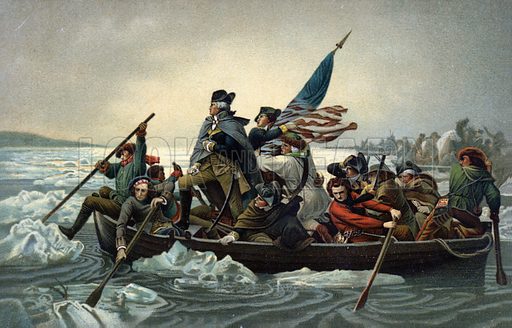
On this date in 1776, “George Washington’s retreating army crosses the Delaware River from New Jersey to Pennsylvania” (https://www.onthisday.com/today/events.php).
Washington and his army had lost New York in late August of 1776, and had retreated through New Jersey, being chased by Sir William Howe and his redcoats. It was the low point of the Revolution for Washington. His army was shrinking because enlistments were up, and it was getting more and more difficult to inspire men to stay and fight. It looked a little bit hopeless.
So Washington “ordered all available boats along the Delaware River to be commandeered. In early December he used this flotilla to cross the Delaware into Pennsylvania at Trenton, successfully putting the river between his army and the British” (https://www.wcpa-nj.com/crossing). Washington even hid the boats from the sight of the New Jersey side of the river. This ploy prevented the Deutsch mercenaries, called the Hessians, from crossing over the Delaware to take Philadelphia. They did, however, take control of Trenton, NJ.
Of course, just two and a half weeks later Washington and 2400 members of the Continental Army would cross back over the Delawar on the night of Christmas Day, attacking the Hessians early in the morning of December 26, in the middle of a winter storm. Having celebrated the day before, and not expecting any action in the middle of a storm, the Hessians were not prepared for the attack. The victory following the famous Christmas Day crossing of the Delaware turned the tide of the war.
I’m not a big fan of wars. I have never had a strong desire to visit famous battlefields or castles. In fact, I do not understand the need that some people, particularly political leaders, have to invade other countries or control what people do using military might. Why can’t people just leave people alone?
But I’m willing to give a nod to George Washington and the Continental Army because what they were fighting for was the freedom to do what they wanted. The British, especially King George, I suppose, felt that they had a God-given right to tell people thousands of miles away what they could and could not do. The colonists, some from England but many from other places, got tired of it and decided to throw off the yoke. By winning the war and driving out the British governors, the Americans created a laissez-faire society, at least for a few years. Like all good things, it didn’t seem to last.
Today’s image is of “George Washington crossing the Delaware during the American War of Independence, 25 December 1776. After Emanuel Gottlieb Leutze, German (1816–68)” (https://www.lookandlearn.com/history-images/XD453792/George-Washington-crossing-the-Delaware-during-the-American-War-of-Independence-25-December-1776). I couldn’t find any images of the December 8 crossing. I guess we have more interest in victories than in losses, unlike the Anglo-Saxons.