Word of the Day: Lagniappe
Today’s word of the day, thanks to the Words Coach (https://www.wordscoach.com/dictionary), is lagniappe. Pronounced / lænˈyæp / or / ˈlæn yæp / (the difference is the stress), it means “a small gift given with a purchase to a customer, by way of compliment or for good measure,” “a gratuity or tip,” or “an unexpected or indirect benefit” (https://www.dictionary.com/browse/lagniappe).
It entered the language around the year “1849, from New Orleans creole, of unknown origin though much speculated upon. Originally a bit of something given by New Orleans shopkeepers to customers. Said to be from American Spanish la ñapa ‘the gift.’ Klein says this is in turn from Quechua yapa ‘something added, gift’” (https://www.etymonline.com/search?q=lagniappe). The etymonline website then provides a quote from Mark Twain, which is also quoted and to some extent explained by Merriam-Webster.
“’We picked up one excellent word,’ wrote Mark Twain in Life on the Mississippi (1883), ‘a word worth traveling to New Orleans to get; a nice limber, expressive, handy word—”lagniappe”…. It is Spanish—so they said.’ Twain encapsulates the history of lagniappe quite nicely. English speakers learned the word from French-speaking Louisianians, but they in turn had adapted it from the American Spanish word la ñapa. (What Twain didn’t know is that the Spanish word is from Quechua, from the word yapa, meaning ‘something added.’) Twain went on to describe how New Orleanians completed shop transactions by saying ‘Give me something for lagniappe,’ to which the shopkeeper would respond with ‘a bit of liquorice-root, … a cheap cigar or a spool of thread.’ It took a while for lagniappe to catch on throughout the country, but in time, New Yorkers and New Orleanians alike were familiar with this ‘excellent word’” (https://www.merriam-webster.com/dictionary/lagniappe).
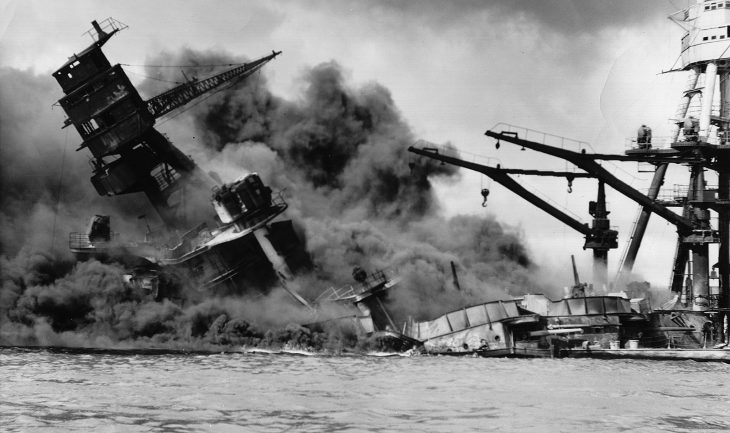
On this date in 1941, “The Imperial Japanese Navy, with 353 planes, attacks the US fleet at Pearl Harbor Naval Base, Hawaii, killing 2,403 people” (https://www.onthisday.com/events/december/7). In addition, “Imperial Japanese Navy attacks US Naval Air Station Kaneohe Bay, Hawaii; 18 sailors killed, 33 of 36 patrol planes destroyed or damaged, 1st Japanese aircraft shot down in action” and “Japanese Emperor Hirohito signs a declaration of war on the United States and the British Empire” (ibid.).
When I was in school, I learned that FDR wanted to stay out of another international war (the Great War had ended just two decades earlier, which is like a major international war having happened in the late 2000s) despite what was going on in Europe, and then, all of a sudden, out of the blue, for no apparent reason, Japan bombed our fleet at Pearl Harbor, forcing us to join the war. That’s not quite what happened.
According to Sarah Pruitt, writing on the History.com website, “During the Great Depression of the 1930s, Japan sought to solve its economic and demographic woes by forcing its way into China, starting in 1931 with an invasion of Manchuria. When a commission appointed by the League of Nations condemned the invasion, Japan withdrew from the international organization; it would occupy Manchuria until 1945” (https://www.history.com/articles/why-did-japan-attack-pearl-harbor).
After Japan renewed the Sino-Japanese conflict and conquered the city of Nanking, leading to mass war crimes, “the United States began passing economic sanctions against Japan, including trade embargoes on aircraft exports, oil and scrap metal, among other key goods, and gave economic support to Guomindang forces. In September 1940, Japan signed the Tripartite Pact with Germany and Italy, the two fascist regimes then at war with the Allies.
“Tokyo and Washington negotiated for months leading up to the Pearl Harbor attack, without success. While the United States hoped embargoes on oil and other key goods would lead Japan to halt its expansionism, the sanctions and other penalties actually convinced Japan to stand its ground, and stirred up the anger of its people against continued Western interference in Asian affairs.
“To Japan, war with the United States had become to seem inevitable, in order to defend its status as a major world power. Because the odds were stacked against them, their only chance was the element of surprise” (ibid.).
The Japanese thought that they would be able to destroy not only the USA’s ability to effectively wage war against Japan in the Pacific by knocking out much of the Pacific fleet but also the willingness of the American people to fight another war. But the attack was not as successful as the Japanese had hoped it would be. One might even say that it accomplished the exact opposite of what they wanted because it awoke a sleeping giant. The USA not only joined battle with the Japanese in the Pacific but also declared war on Deutschland and Italy, joining with its European allies to eventually defeat the Axis powers.
In fact, one might even say that the attack on Pearl Harbor came with a lagniappe (unexpected benefit) for the rest of the world.
Today’s image is of “A U.S. battleship sinking during the Pearl Harbor attack” (https://www.britannica.com/event/Pearl-Harbor-attack).