December 5 Victual
Today’s word of the day, courtesy of the Words Coach (https://www.wordscoach.com/dictionary), is victual. Pronounced / ˈvɪt l /, which sounds more like the non-standard spelling vittle (https://www.dictionary.com/browse/victual), we usually find it in its plural form, victuals (pronounced / ˈvɪt lz /). It means “food or provisions for human beings” (ibid.) Merriam-Webster says that it can also be used as a transitive verb, “to supply with food,” or an intransitive verb, “to lay in provisions” (https://www.merriam-webster.com/dictionary/victualshttps://www.merriam-webster.com/dictionary/victuals).
M-W goes on at length about the background of the noun: “If you’re hungry for the story behind victual, get ready to dig into a rich and fulfilling history. The word derives via the Middle English and Anglo-French vitaille from the Late Latin plural noun victualia (‘provisions’), and ultimately (by way of victus, meaning ‘nourishment’ or ‘way of living’) the Latin verb vivere, meaning ‘to live.’ Vivere is the source of a whole smorgasbord of other English words, such as vital, vivid, and survive. It’s also the root of viand, another English word referring to food. There’s also vittles, a word that sounds like it might be an alteration of the plural victuals (both are pronounced /VIT-ulz/) but which is actually just an earlier development of the Middle English vitaille that was served before victual’” (ibid.).
When you look for victual on the Etymonline.com page, it redirects you too victuals. Victuals entered the language “c. 1300, vitaylle (singular but the word is typically plural in Middle and Modern English), ‘food, food and drink; a stock of food and drink for warfare or travel,’ from Anglo-French and Old French vitaille ‘food for humans, nourishment, provisions,’ from Late Latin victualia ‘provisions.’ This is a noun use of plural of victualis ‘of nourishment,’ from victus ‘livelihood, food, sustenance, that which sustains life,’ from past participle stem of vivere ‘to live’ (from PIE root *gwei- ‘to live’).
English forms in -ct- are attested from c. 1400, and the classically correct spelling predominates from early 16c., but the pronunciation remains stubbornly ‘vittles.’” And here I thought that “vittles” was an American Southernism.
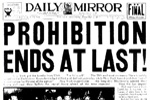
On this date in 1932, “Prohibition ends in the US at 5:32 PM EST when the 21st Amendment to the US Constitution is ratified, repealing the 18th Amendment” (https://www.onthisday.com/events/december/5). December 5 is thus National Repeal Day.
“The turn of the twentieth century was a dark time in America. The Women’s Christian Temperance Union, which had been promoting Prohibition for many years, believed alcohol was the cause of many, if not all, social ills. Mistruths like this were spread. Lines were drawn. Bars and taverns were vandalized. People were killed. On January 16th, 1919, Congress passed the Eighteenth Amendment, outlawing alcohol and ostensibly putting an end to drunkenness, crime, mental illness, and poverty” (http://repealday.org/). Actually, Prohibition started a year later, in 1920, with the passage of the Volstead Act, which enabled enforcement of the 18th Amendment.
That was the intent. But what did Prohibition actually achieve?
First of all, the one-year break between passage of the Amendment and its implementation gave an opportunity for the well-heeled to stock up on booze. “Historian Lizabeth Cohen writes: ‘A rich family could have a cellar-full of liquor and get by, it seemed, but if a poor family had one bottle of home-brew, there would be trouble.’ Working-class people were inflamed by the fact that their employers could dip into a private cache while they, the employees, could not. Within a week after Prohibition went into effect, small portable stills were on sale throughout the country” (https://en.wikipedia.org/wiki/Prohibition_in_the_United_States).
Americans want to be able to have a drink, and the 18th Amendment made that difficult to do legally. So Prohibition fostered criminal activity; “before the passing of the 18th Amendment in 1919 and the nationwide ban that went into effect in January 1920 on the sale or importation of ‘intoxicating liquor,’ it wasn’t the mobsters who ran the most organized criminal schemes in America, but corrupt political ‘bosses,’ explains Howard Abadinsky, a criminal justice professor at St. John’s University and author of Organized Crime” (https://www.history.com/articles/prohibition-organized-crime-al-capone).
“The key to running a successful bootlegging operation, Abadinsky explains, was a paramilitary organization. At first, the street gangs didn’t know a thing about business, but they knew how to handle a gun and how to intimidate the competition. They could protect illegal breweries and rum-running operations from rival gangs, provide security for speakeasies and pay off any nosey cops or politicians to look the other way.
“It wasn’t long before the mobsters were raking in absurd amounts of money and it was bosses and cops who were taking the orders. As the money kept pouring it, these formerly small-time street thugs had to get smart. They had to hire lawyers and accountants to launder the millions in ill-gotten cash piling up each month. They had to start thinking about strategic partnerships with other gangs and shipping logistics and real estate investment.
“’They had to become businessmen,’ says Abadinsky. ‘And that gave rise to what we now call organized crime’” (ibid.).
Organized crime still exists in America, but after December 5, 1932, it had to branch out into other criminal activities—gambling, prostitution, loan sharking, and even drugs. One of the arguments for creating state-run lotteries in the United States was that allowing such legalized gambling would hurt organized crime. A similar argument has been made for legalizing prostitution, or sex work as some people call it, though very few places in the USA have legalized prostitution. And similar arguments have also been made related to the legalizing of cannabis, which has been legalized in a majority of the states in the USA.
Personally, while I enjoy an occasional beer or glass of wine, I cannot drink anything harder than that. And I don’t use any drugs, but I think legalizing drugs would be smarter than blowing up boats in the Caribbean. I do not consider alcohol a type of victuals, but I encourage celebrating National Repeal Day.
Today’s image is of a newspaper headline from 1932 (http://repealday.org/).