Word of the Day: Zetetic
Today’s word of the day, courtesy of the Word Guru daily email, is zetetic. Pronounced / zəˈtɛtɪk /, with them emphasis on the second syllable (https://www.dictionary.com/browse/zetetic), this adjective means “proceeding by inquiry or investigation,” “of or related to an ancient Greek school of philosophy that espoused extreme skepticism,” or “believing in or based on the theory that the earth is a flat plane and the sun, moon, and other heavenly bodies are only a few thousand feet above it” (ibid.).
Merriam Webster is a bit more specific: “skeptic, seeker; specifically: one of a group of Pyrrhonist philosophers” (https://www.merriam-webster.com/dictionary/zetetic). According to the wiki, “Pyrrhonism is named after Pyrrho of Elis, a Greek philosopher in the 4th century BCE who was credited by the later Pyrrhonists with forming the first comprehensive school of skeptical thought” (https://en.wikipedia.org/wiki/Pyrrhonism). Pyrrhonism became “the dominant school of skepticism in the early Roman period” (ibid.). “The goal of Pyrrhonism is ataraxia, an untroubled and tranquil condition of soul that results from a suspension of judgement, a mental rest owing to which we neither deny nor affirm anything” (ibid.).
The word entered the English language in the “1640s, from Modern Latin zeteticus, from Greek zētētikos ‘searching, inquiring,’ from zētetos, verbal adjective of zētein ‘seek for, inquire into’” (https://www.etymonline.com/word/zetetic). I’m not sure what the connection between “searching” and “inquiring” is with being a flat earther, but maybe it has to do with being skeptical of modern science.
On this date in 1950, according to the On This Day website, “I Robot collection of sci-fi short stories by Isaac Asimov published by Gnome Press in the US” (https://www.onthisday.com/today/events.php).
I, Robot is what is called a fix-up, or a fix-up novel. A fix-up is a novel, of sorts, created from a collection of previously published short stories. In the case of Asimov’s novel, he created a frame story to justify the inclusion of the stories. In the frame story, a journalist is interviewing Dr. Susan Calvin, the world’s first robo-psychologist. She is reflecting on her career working with robots, and that serves as the premise for telling the journalist the various stories.
Asimov got an undergraduate degree in chemistry from Columbia; he then applied twice to medical school, getting accepted neither time. He then went for a masters degree in chemistry and then a Ph.D. After receiving his doctorate and doing a year of post-doc work, he was offered a position as associate professor of biochemistry at the Boston University School of Medicine, an offer that could not have escaped his sense of irony.
He also began writing, and science fiction was his chosen genre. What prompted him to write about robot was a trend that he saw in 1930s speculative fiction. The trend dates back to 1921, when Karel Čapek’s sci-fi play R.U.R. was first produced. “’R.U.R.’ stands for Rossumovi Univerzální Roboti (Rossum’s Universal Robots” (https://en.wikipedia.org/wiki/R.U.R.). Spoiler alert: at the end of R.U.R., the robots have taken over the world and are wiping out all the humans. Such stories quickly became a staple of science fiction. Asimov was actually bothered by this trend, and he began writing stories that presented robots in a positive light.
My wife likes thrift stores. One year I took her to a store called Helping Hands. My usual approach is to sit in the car and read, but on this one occasion I forgot my book (this is before Kindles and iPads). So I went into the store and went to the little section of books where I found a halfway falling apart copy of I, Robot. I took it out to the car and began to read. When I was finished, I moved on to Asimov’s robot novels, which are science-fiction detective novels. Then I moved on to the Foundation series, and the second Foundation series, in which the robots from the earlier robot novels play a very important role. I even wrote a paper about the whole series which I read at the Midwestern Conference on Christianity and Literature; it was called, “Who is God When God Is Dead?” and it focused on how the robots eventually become the saviors of humankind throughout the galaxy.
And then there’s the movie with Will Smith. The movie (I don’t really encourage seeing it) has almost nothing to do with Asimov’s novel other than the title and the name of the principal female character, who shares a name and almost nothing else with the Susan Calvin of the book. In the movie, a robot superbrain or something builds an army of robots with the goal of taking over the planet and eliminating all the people. It sounds like it should have been called R.U.R., II, instead of I, Robot.
The sad part of my experience is that, while I love the optimism of Asimov, I am zetetic when it comes to Hollywood and its ability to understand anything other than box office and the bottom line.
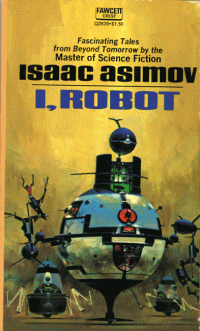
Today’s image is of one of the many different covers for Isaac Asimov’s I, Robot.